
Why Clinical Supervision Matters (and Why WisePractice Created a 40-Hour Training You’ll Actually Want to Take)

The WisePractice Supervisor’s Companion Workbook — a comprehensive guide designed to support learning throughout the course and serve as a practical resource long after the training ends.
What does it really mean to be a clinical supervisor?
Supervision is one of the most impactful—and often most misunderstood—roles in the mental health profession. It’s not just about oversight. It’s about growth, ethics, power, relationships, accountability, and helping another clinician develop the judgment necessary to practice well.
Whether you’re a Texas LPC or LMFT preparing to become a supervisor, or you’ve been supervising for years and could use renewed clarity and support, one thing remains true:
Supervision shapes the future of our field.
That belief is at the heart of the WisePractice Institute 40-Hour Clinical Supervision Training.
More Than Just a Requirement
Texas LPCs and LMFTs pursuing supervisor designation have specific educational requirements to meet. But completing the required hours is only one part of preparing to supervise another clinician.
The transition from clinician to supervisor brings new responsibilities: evaluating competence, giving difficult feedback, attending to power and culture, documenting supervision, navigating ethical dilemmas, balancing support with accountability, and protecting client welfare while supporting supervisee development.
A meaningful supervision training should prepare you for those realities—not simply introduce the rules.
The WisePractice course is designed as a layered learning experience that moves between knowledge, reflection, and practical application.
Inside the course you’ll find:
✔ The Supervisor’s Companion Workbook — a comprehensive guide designed to support learning throughout the course and serve as a practical resource long after the training ends.
✔ Engaging Didactic Instruction — clear, research-grounded, and board-aligned teaching that makes complex supervision concepts approachable and applicable.
✔ Case-Based Learning — realistic supervision situations that invite you to think through complexity, competing responsibilities, and the kinds of decisions supervisors actually face.
✔ Guided Reflection & Application — opportunities to examine your developing supervisor identity, values, assumptions, strengths, and areas for continued growth.
✔ Practical Tools & Resources — materials designed to help translate what you learn into your own supervision practice.
The goal is not simply to know more about supervision at the end of 40 hours.
It’s to be better prepared to practice supervision thoughtfully.
What the Training Covers
Across six comprehensive modules, the course addresses essential foundations such as supervision theory, ethics, documentation, board rules, evaluation, and supervisory methods—as well as some of the complexities that are harder to capture in a checklist:
✔ Gatekeeping, evaluation, and power dynamics
✔ Cultural humility and responsiveness in supervision
✔ Navigating supervisee challenges—and your own reactions to them
✔ Giving feedback and having difficult conversations
✔ Supervisor development, sustainability, and self-care
✔ Building a strong, ethical supervisory alliance
✔ Translating supervision theory into real-world decisions
Throughout the training, reflection and application are woven into the learning process because becoming a supervisor isn’t simply about acquiring another set of skills. It also involves developing a new professional identity.
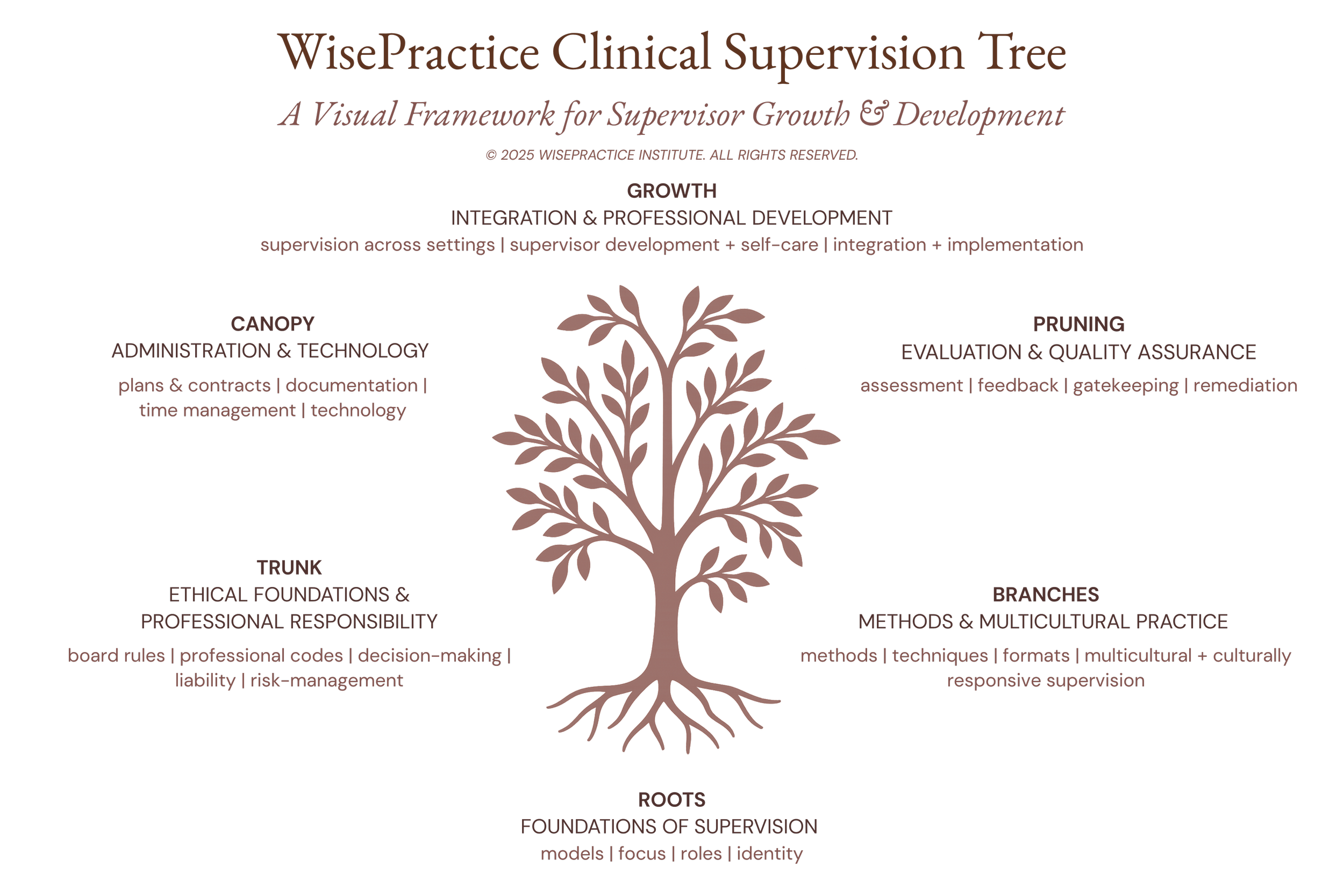
Course Modules at a Glance
Our training follows the WisePractice Tree Metaphor, where each stage of growth reflects the foundations and skills of supervision.
MODULE 1: ROOTS - Foundations of Supervision (8 hours)
Grounding Knowledge, Theory, and Professional Identity
Lesson 1: Introduction to Clinical Supervision
Lesson 2: Supervision Models and Frameworks
Lesson 3: Focus Areas of Supervision
Lesson 4: Supervisory Roles and Identity
MODULE 2: TRUNK - Ethical Foundations and Professional Responsibility (6 hours)
Core Ethical Principles and Legal Framework
Lesson 5: Core Ethical Principles
Lesson 6: Boundaries and Dual Relationships
Lesson 7: Supervisor Liability and Risk Management
MODULE 3: BRANCHES - Methods and Multicultural Practice (8 hours)
Diverse Approaches and Cultural Responsiveness
Lesson 8: Core Supervision Methods and Techniques
Lesson 9: Supervision Formats and Modalities
Lesson 10: Multicultural and Culturally Responsive Supervision
MODULE 4: PRUNING - Evaluation and Quality Assurance (6 hours)
Assessment, Gatekeeping, and Professional Standards
Lesson 11: Assessment and Evaluation
Lesson 12: Feedback and Difficult Conversations
Lesson 13: Gatekeeping and Remediation
MODULE 5: CANOPY - Administration and Technology (6 hours)
Structure, Documentation, and Digital Integration
Lesson 14: Supervision Plans and Contracts
Lesson 15: Documentation and Time Management
Lesson 16: Technology Integration
MODULE 6: GROWTH - Integration and Professional Development (6 hours)
Synthesis, Implementation, and Ongoing Development
Lesson 17: Supervision Across Settings
Lesson 18: Supervisor Development and Self-Care
Lesson 19: Integration and Implementation
Who This Training Is For
This course is designed for:
✔ Texas LPCs and LMFTs preparing to pursue supervisor designation.
✔ Current supervisors who want to revisit the foundations, strengthen their skills, or bring renewed intention to their supervision practice.
✔ Clinicians across settings—including schools, nonprofits, agencies, group practices, and private practices—who want practical supervision education grounded in research, ethics, and real-world clinical practice.
LCSWs, psychologists, and other mental health professionals may also find the course valuable for continuing education and professional development. However, WisePractice’s 40-Hour Clinical Supervision Training does not satisfy the training requirement for Texas social workers seeking supervisor status due to the state’s license-specific instructor requirements.
Participants should review their licensing board’s current requirements to determine how a particular training applies to their license.
Why It Matters
Clinical supervision isn’t just about paperwork or passing along clinical skills.
It’s one of the places where developing clinicians learn how to think through uncertainty, recognize the limits of their competence, receive and integrate feedback, navigate ethical complexity, and grow into their own professional identities.
Done well, supervision strengthens individual clinicians, supports client welfare, and contributes to the integrity of the profession.
Good supervision also requires more than having all the answers.
It requires the ability to ask thoughtful questions. To balance support with accountability. To recognize complexity without becoming paralyzed by it. To know when to guide, when to challenge, when to teach, and when to make room for someone else to find their own clinical voice.
That’s the kind of supervision WisePractice is designed to cultivate.
Guided by wisdom. Rooted in practice. Grown with passion.

Learn more about the WisePractice 40-Hour Clinical Supervision Training →

In gratitude and community,
Chelsea Fielder-Jenks, LPC-S, CEDS-C, PMH-C
WisePractice Institute Founder & Director