
January 2026 Texas Psychology Board Meeting Recap: What Licensees Need to Know
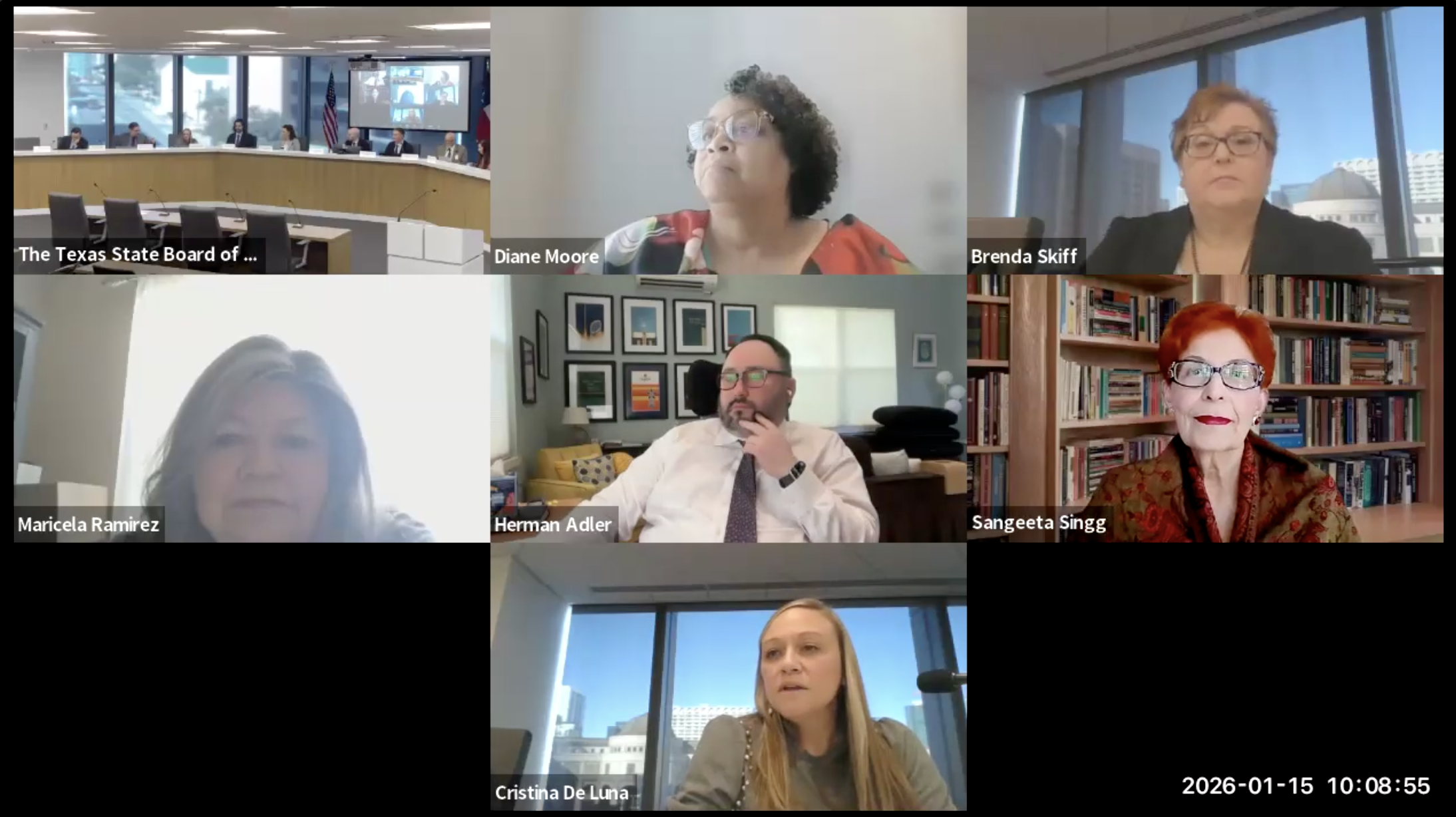
The January 15, 2026 Texas Psychology Board meeting:
Board members, staff, and stakeholders convened to discuss licensure updates, policy developments, and key regulatory priorities impacting Texas Psychologists.
The Psychology Board’s January meeting was a practical, systems-focused start to the year: new staff leadership, committee restructuring, major reminders on CE Broker for renewals, an Memorandum of Understanding to address school psychology workforce gaps, multiple licensing and enforcement actions, and final adoption of a bundle of rules tied to recent legislation.
Below are the highlights that are most likely to impact Texas psychologists, LPAs, and school psychologists.
📌
Notice of Proposed PSYPACT Rules
The PSYPACT Commission has released proposed revisions to Rule 10 and is seeking public comment. The revisions would (1) establish a process for reviewing and adjusting the formula used to calculate Annual Assessment fees charged to member states, and (2) cap the maximum Annual Assessment fee at $6,000 per jurisdiction.
The proposed rules are open for a 60-day public comment period, with written comments due by 5:00 p.m. EST on February 20, 2026. Comments must be submitted through the online form provided by the Commission.
Final approval of the rules will be considered at the PSYPACT Commission’s Midyear Meeting on July 13, 2026, held via Zoom. Details about the meeting will be posted on the PSYPACT website (https://psypact.gov/page/Meetings) at least 30 days beforehand. Public comments submitted will remain visible on the PSYPACT website until the close of the comment period.
Big picture takeaways
New Board Administrator and committee reshuffle
The Board welcomed Christina Deluna as the new Board Administrator (coming from about a decade with the LPC board).
The Chair outlined committee reassignments, including:
Eliminating the separate jurisprudence exam writing task force and rolling the work into the Jurisprudence Committee.
Updating the Applications Committee membership.
Continuing the Rules Committee, with the Chair joining going forward.
Eliminating the Compliance Committee and moving toward rotational ISCs (Informal Settlement Conferences) that involve more board members, including public members, to spread workload and increase participation.
→ WisePractice Takeaway: this signals a process shift toward broader board involvement in disciplinary conferences and a more consolidated approach to jurisprudence exam development.
BHEC updates that affect renewals, coordinated care, tech, and complaints
Board delegates highlighted several Executive Council-level actions and discussions that impact licensees across disciplines, including psychology:
Incomplete applications now expire after 180 days if not completed (noted as adopted at the Executive Council level).
Supervised experience clarification: the qualifying period begins at license issuance (important for tracking and documentation).
Delinquent to inactive status flexibility: easier transitions for licensees in career changes.
Coordinated care rule language: emphasizes client consent before contacting other providers and encourages coordinated care when clients see multiple professionals.
Emerging practices and technology:
Continued discussion of AI and new technology. The Council has taken a “use existing ethics standards as the foundation” approach, paired with a guidance document on emerging practices and technology.
The Council discussed an AI regulatory sandbox framework. Rule drafting is not expected to begin until the statewide program framework is established by the state technology agency.
Ketamine-assisted therapy:
The Council held a large public town hall and is monitoring the topic. The consistent message was: ethical standards already guide core duties (competence, training, confidentiality), while regulators continue assessing whether additional regulation is needed.
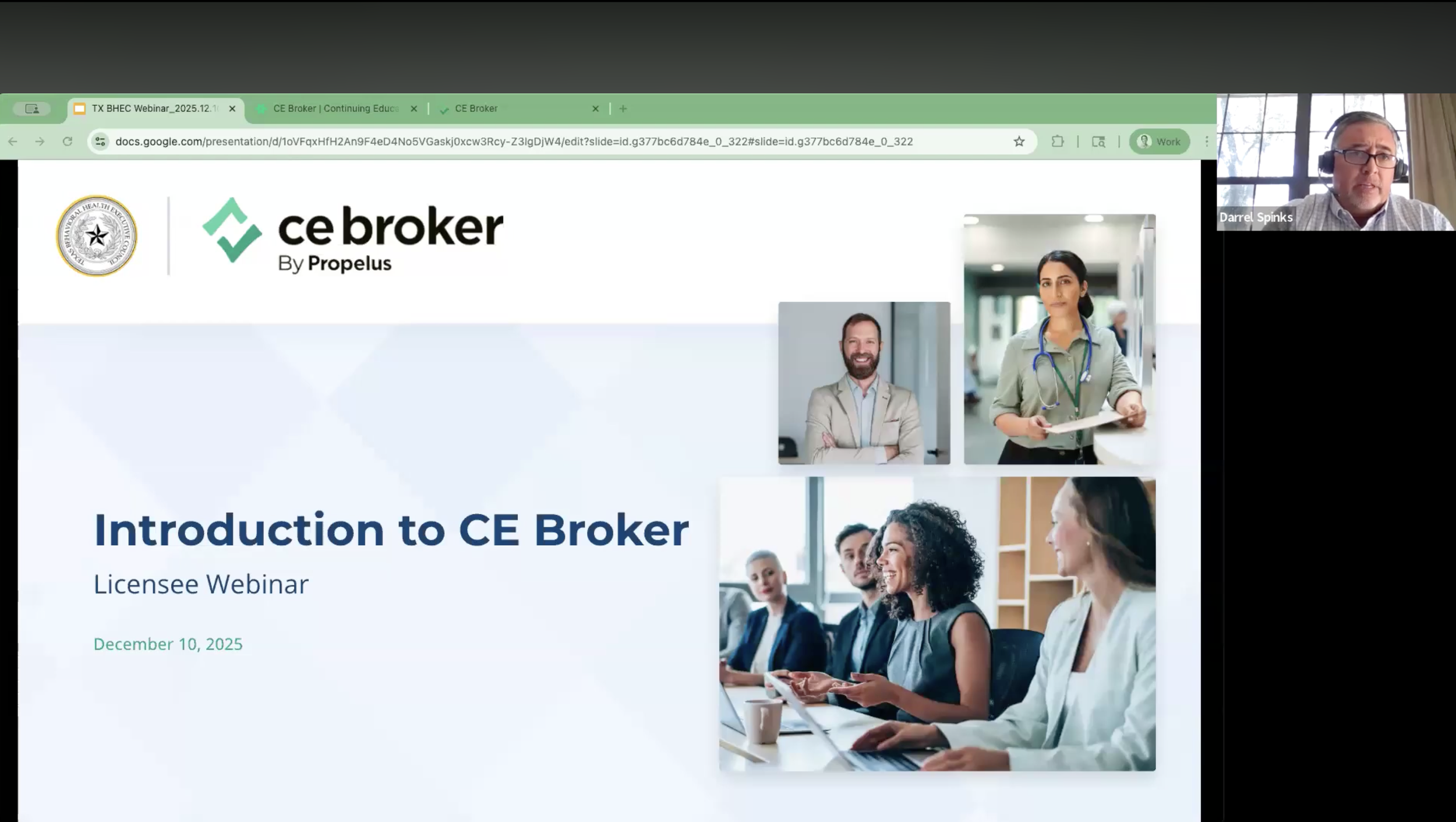
CE reporting has changed for all BHEC licensees. As of January 1, 2026, all continuing education must be tracked and reported through CE Broker. Learn more in our previous blog for a deeper dive into navigating the platform.
CE Broker: the must-know reminder
Staff emphasized that beginning January 1, 2026, renewals require a CE Broker account and CE reporting through CE Broker for the online renewal process to proceed.
A free basic account is sufficient. A paid subscription is optional and not required.
→ WisePractice Takeaway: Set up your CE Broker account now, add your CEs as you go (rather than trying to upload last minute), to avoid renewal delays.
Board actions and decisions
Election actions
The Board reelected Chair Ryan Bridges as the public member delegate to BHEC (required on the even-year cycle).
The Board elected Dr. Roxanna Lamden as Vice Chair, re-establishing a backup leadership function for continuity.
MOU approved: Abilene Christian University and ESC Region 20 School Psychology Retraining Program
The Board approved a Memorandum of Understanding (MOU) with Abilene Christian University (ACU) and Education Service Center Region 20 for a School Psychology Retraining Program.
What stood out in the discussion:
The program was designed to remove barriers for retraining candidates while still aligning with Texas requirements.
ESC Region 20’s role includes addressing a major bottleneck: supervision access in areas where many counties reportedly have zero school psychologists, which also impacts internship supervision capacity.
The program is primarily online, with required in-person residency weekends scheduled during the summer.
The MOU functions as a “pre-vetting” mechanism so future applicants from the program do not require repeated transcript-by-transcript evaluation, assuming the program and rules remain consistent.
→ WisePractice Takeaways: this is a clear workforce pipeline strategy that also protects applicants by clarifying that the retraining curriculum aligns with Texas requirements.
Licensing matters
The Board handled a small set of application/appeal items, with the key theme being how the Board uses remediation authority when an applicant is otherwise qualified but has a discrete training-hour deficiency.
→ WisePractice Takeaways:
Remediation vs. denial: The Board emphasized both public protection and fairness when deficiencies are procedural and can be remediated without reducing the total supervised experience expectation.
Why this matters for applicants and supervisors: It reinforces the importance of verifying Texas-specific hour requirements early (especially internship hour totals and timing) and maintaining clean documentation, because the Board may be able to remediate some gaps (but not all) and the process can slow licensure timelines.
Examination matters
Jurisprudence exam modules: ongoing revisions
Staff reported continued work on improving jurisprudence exam content, including revisions to a module that were sent to the vendor.
No vote was needed on this item.
→ WisePractice Takeaway: expect continued incremental updates to format and content.
Enforcement matters
The Board reviewed multiple enforcement items, including cases that were in a default posture (i.e., the respondent did not participate at the SOAH stage), and voted on proposed orders.
→ WisePractice Takeaways:
Credential integrity is a top-tier issue: The Board approved action in a case involving false or unverifiable educational credentials. Expect aggressive follow-through when documentation suggests misrepresentation.
Boundary and professionalism issues remain central: The Board supported strong sanctions where allegations involved serious boundary violations, problematic conduct in public settings, documentation problems, and related integrity concerns.
Competency/noncompliance can drive revocation: In a case involving a competency process and repeated noncompliance with required evaluations, the Board favored revocation as the mechanism to protect the public, while preserving a pathway for future reapplication with proof of fitness/competence.
Participation matters: Several matters were resolved without the respondent present, underscoring that nonresponse/nonappearance increases the likelihood of severe outcomes and reduces opportunities to provide context, mitigation, or corrective plans.
Rulemaking: Adoption of Rules
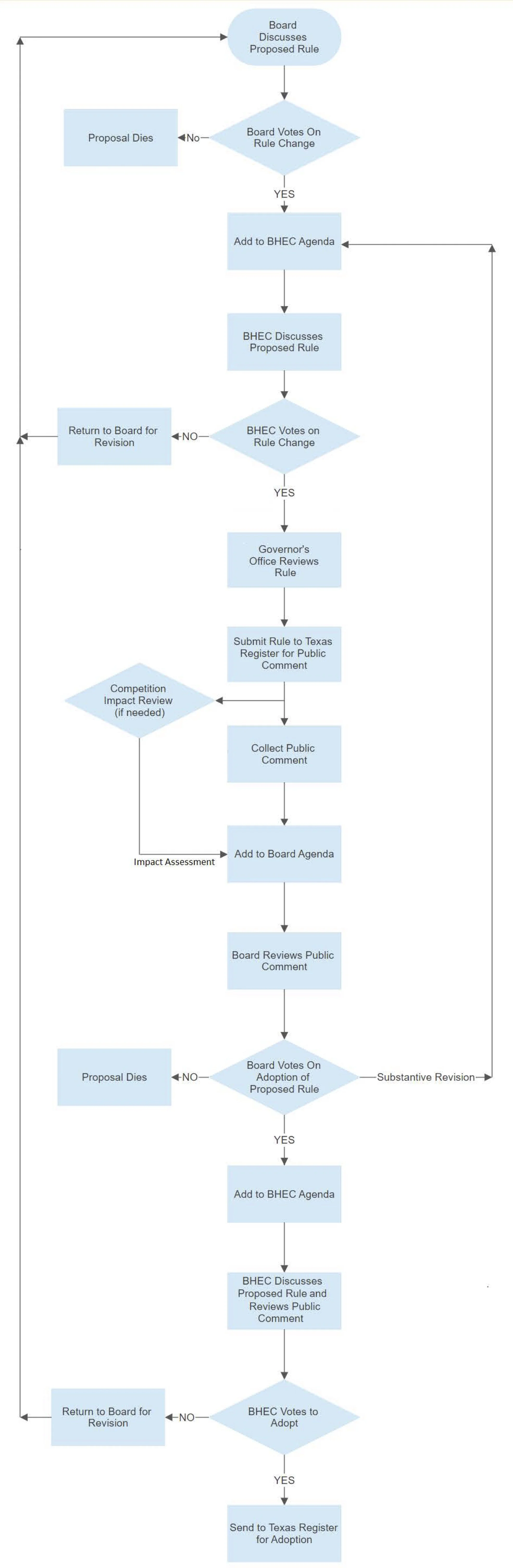
Unfamiliar with the BHEC Rulemaking Process? Here’s a map that delineates the process. Source: https://bhec.texas.gov/wp-content/uploads/2023/03/BHEC-Rulemaking-Process-Map-20230327.pdf
Following the public comment period, the Board adopted the following rules unanimously as a package of rule updates tied primarily to legislative implementation and title/terminology alignment, as well as related conforming edits across supervision, training, and practice standards.. These now return to BHEC for final adoption vote:
§463.8 Licensed Psychological Associate
§463.9 Licensed Specialist in School Psychology
§463.11 Supervised Experience Required for Licensure as a Psychologist
§463.20 Special Provisions Applying to Military Service Members, Veterans and Spouses,
§463.30 Examiners Required for Licensure
§465.1 Definitions
§465.2 Supervision
§465.18 Forensic Services
§465.21 Termination of Services
§465.38 Psychological Services for Schools.
→ WisePractice Takeaway: Most of these amendments were described as legislatively driven or conforming updates, including terminology changes (such as school psychology title alignment), military mobility provisions, and related clean-up edits across supervision, definitions, and practice rules—meaning stakeholder controversy was minimal and implementation is expected to proceed without delay once Council approval is complete.
Curious how a rule progresses from draft language to enforceable regulation?
We’ve included a visual map of the process for reference.
Practical “what to do now” checklist for Texas psychology licensees
If you renew in 2026: create your CE Broker account now and ensure your CE is reported there before you try to renew.
If you supervise or track hours: double-check timelines and documentation practices in light of the emphasis on supervised experience calculation beginning at license issuance and the Board’s ongoing attention to internship and postdoctoral hour integrity.
If you coordinate care: tighten your workflow so you have client consent before contacting other providers and document it consistently.
If you are using AI or new tech tools: anchor your decisions in existing ethical duties (competence, confidentiality, informed consent, documentation), and watch for future sandbox participation rules.
Stay Connected with WisePractice
For ongoing board recaps, ethics updates, and supervision policy analysis, stay tuned to the Collective Wisdom Blog.
Subscribe to the WisePractice newsletter for grounded, practical guidance — translating board decisions into real-world clinical and supervisory practice.

Questions? Feedback? Topics you'd like us to cover in 2026? Let us know in the comments.
Guided by Wisdom. Rooted in Practice. Grown with Passion.
A Quick Disclaimer (Because It Matters)
This recap is intended for informational and educational purposes only and reflects a summary interpretation of the January 15, 2026 Texas State Board of Examiners of Psychologists meeting. It is not an official transcript, legal opinion, or regulatory directive. Licensees are responsible for reviewing board rules, statutes, and formal guidance directly through the Texas Behavioral Health Executive Council (BHEC) and the Psychologists Board. For specific legal, ethical, or licensure questions, consult the relevant statutes, administrative code, or qualified legal counsel.