
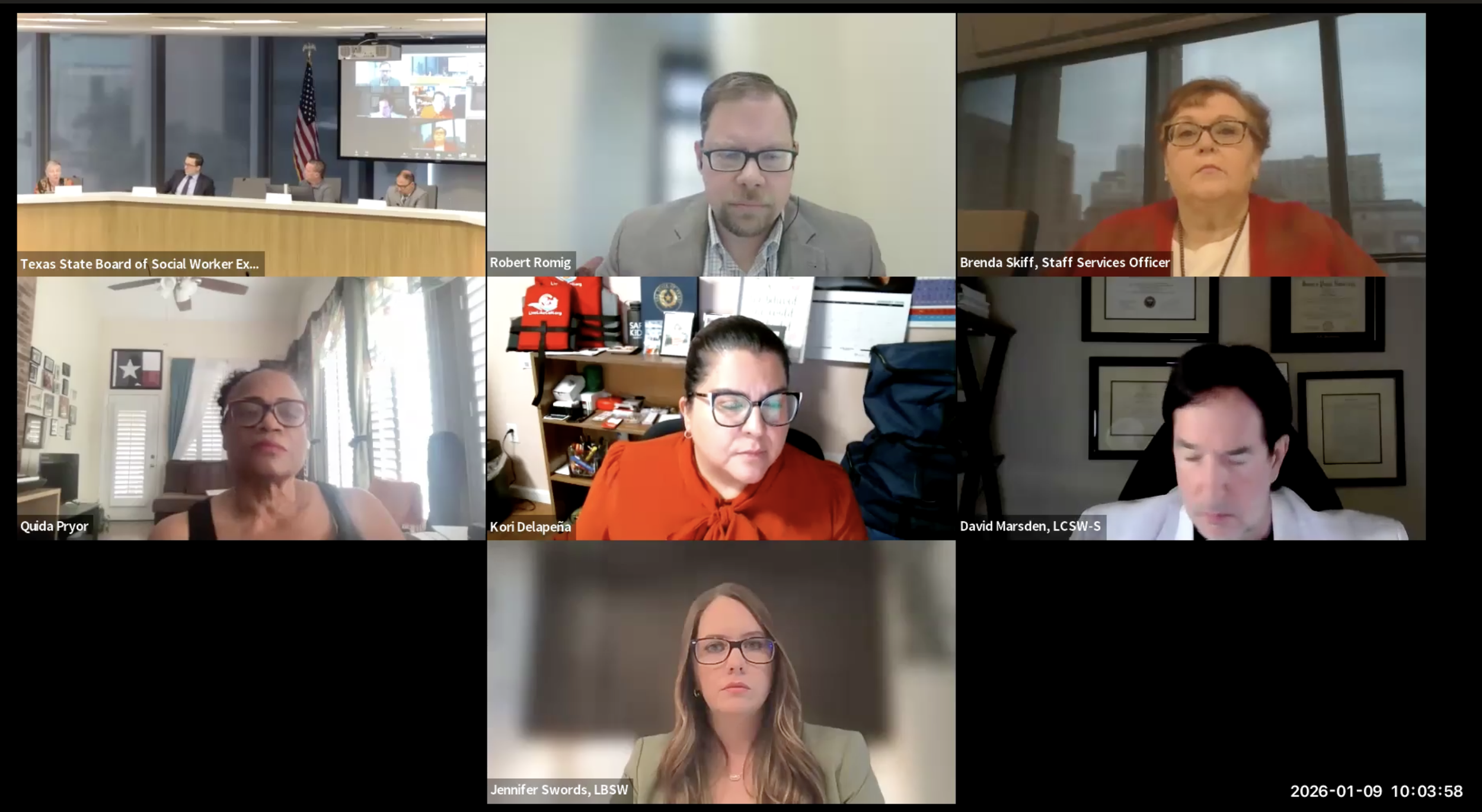
January 9, 2026 — Texas State Board of Social Worker Examiners meeting. Below, we break down the key discussion points and what they mean for Texas social workers and supervisors.
The Texas State Board of Social Worker Examiners met on January 9, 2026, here's what you need to know:
Growth and Legal Updates
Texas social work is growing. The board reported that the state now has over 35,000 licensed social workers—a significant milestone that reflects both the profession's expansion and its critical role in behavioral health across the state.
The Chapter 108 lawsuit continues. The board reported that oral arguments were heard by the 15th Court of Appeals on December 18th. This lawsuit challenges a statute that requires mandatory license denial for certain criminal convictions — a provision that applies only to social work and psychology licenses under the Occupations Code, not LPCs or LMFTs. The court hasn't issued an order yet, and whatever they decide will likely be appealed to the Texas Supreme Court. This litigation is expected to continue for quite some time.
Important Reminder: CE Broker is Now Mandatory
If you haven't set up your CE Broker account yet, do it now. As of January 1, 2026, all licensees must have a CE Broker account to report continuing education. You cannot renew your license without it. You can learn more about CE Broker in our earlier blog, here. Once you're in the system, CE Broker has its own help desk if you run into issues.
For January renewals: Congratulations, you're the trendsetters! Get your CE hours entered into CE Broker immediately. As one board member wisely noted during enforcement discussions: "I think it's extremely important for us as licensees to make sure that you understand when your renewal date is and make sure that you renew prior to that date."
Examination Matters: Jurisprudence Exam Updates
The board reviewed and approved updates to the jurisprudence exam. The details were included in board materials and the motion passed unanimously. These updates ensure the exam reflects current rules and regulations.
Major Rule Changes: A Comprehensive Reorganization
This was the biggest item on the agenda — a complete overhaul of supervision and practice standards. The board voted unanimously to recommend adoption of 17 rule changes to BHEC for final approval in February.
Note: These rules received unanimous approval from the board and will move to the February 2026 BHEC meeting for final adoption. Staff made some technical corrections after the public comment period ended but before the board meeting. While the substance remains the same, the word-by-word language may differ slightly from what was posted in the original public materials. If you need the exact final language, check the February BHEC meeting materials. Once adopted by BHEC, the rules will be published in the Texas Register as final and then incorporated into the consolidated rule book.
What's Being Reorganized
The board is restructuring the entire supervision framework by repealing outdated sections and creating clearer, more logical rules:
Being Repealed:
§781.402 (old version on Clinical Supervision for LCSW and Non-Clinical Supervision)
§781.403 (old version on Independent Practice Recognition)
§781.405 (old version on Application for Licensure)
§781.406 (old version on Required Documentation)
New Structure:
§781.402 Types of Supervision - Clarifies different supervision categories
§781.403 Supervision Process - Details how supervision should be conducted and includes new requirement that supervisees inform supervisors if a complaint is filed against them
§781.404 Recognition as a Supervisor - Requirements for becoming a recognized supervisor
§781.405 Clinical Supervision for LCSW - Specific requirements for clinical supervision toward LCSW
§781.406 Independent Practice Recognition - New framework for independent practice
§781.407 Prohibited Independent Practice - Clear boundaries on what's not allowed
Other Significant Updates
§781.102 Definitions - Revised for consistency across all rules and to eliminate ambiguity in key terms
§781.302 The Practice of Social Work and §781.303 General Standards of Practice - Updated for clarity and alignment with current professional standards
§781.322 Child Custody Evaluations - Updated to reflect current best practices
§781.401 Qualifications for Licensure - Streamlined to remove redundancies
§781.419 Licensing of Military Service Members, Military Veterans, and Military Spouses - Updated to ensure Texas remains responsive to military-connected professionals
§781.805 Schedule of Sanctions - Updated to provide clearer guidance on enforcement actions
Disaster Response: Register Now, Not Later
The board continues encouraging licensees interested in disaster response work to register in advance with organizations like the Red Cross rather than waiting until disaster strikes.
Lesson from July flooding: Well-meaning volunteers who showed up unregistered sometimes created additional resource burdens on already overwhelmed communities (needing food, shelter, coordination).
How to prepare: Visit the board's Disaster Preparedness page for information on how to register your professional expertise so it can be quickly deployed when actually needed.
Ketamine-Assisted Therapy: The Conversation Continues
The board held a December 18th town hall on Ketamine-Assisted Therapy, focusing on ethical practice, patient safety, and professional standards. Administrator Sarah Faszholz provided a report on attendance and feedback.
Chair Brumley's national perspective: At a November meeting in Indianapolis, there was significant discussion nationwide about whether professional liability insurance will cover social workers participating in ketamine-assisted therapy and other emerging psychedelic-assisted treatment modalities (like psilocybin).
The gray area problem: These are emerging treatment modalities without clear regulatory frameworks yet. Social workers getting involved may find themselves in situations where:
Their insurance doesn't cover them
The legal landscape is uncertain
Professional standards haven't caught up to practice reality
The board's recommendations if you're involved in this area:
Seek supervision - Don't practice in isolation
Contact your professional liability insurance provider - Verify coverage explicitly
Stay informed - The Texas Medical Board is actively looking into ketamine-assisted therapy and may be developing rules. Since social workers can't prescribe, there will likely be overlap between TMB regulations and social work practice standards.
Current status: The board is in a fact-gathering stage, watching what TMB does, and determining whether additional regulation is needed for social work practice in this area.
The Human within the Healer: Two Appeals Worth Noting
At the January 9th meeting, the board heard two compelling license appeals that illuminate how regulatory bodies balance public protection with recognition of genuine rehabilitation and professional growth.
When Recovery Meets Professional Practice
In a particularly moving case, the board considered an applicant with three alcohol-related convictions between 2016 and 2023. What stood out wasn't the past offenses—it was the transformation that followed. The applicant had completed incarceration, remained compliant with probrobation, and was working as a crisis counselor at Integral Care in Austin since September 2024.
Her supervisor's testimony was powerful: "If somebody was going to have a hard day, if they were going to relapse, if they were going to not push through, this is the work that will push you to that point. And she never has shown any suggestion or indication that she isn't capable of doing that work."
The board approved licensure with conditions:
Continue attending NA or AA for one year
Enroll in individual therapy
Quarterly reporting to staff
This decision reflects something we emphasize at WisePractice: recovery and professional competence can absolutely coexist. The board didn't ignore the history—they weighed it alongside demonstrated accountability, stability, and ongoing commitment to sobriety.
The Chapter 108 Challenge
Another applicant faced the harsh reality of Chapter 108—a provision that essentially creates mandatory license denials for certain criminal convictions. Unlike the first case, where the board had discretion, Chapter 108 removes that flexibility entirely for specific offenses.
Interestingly, this applicant had held a Texas LCDC license since 2018 and had been successfully working with vulnerable populations for over a decade. The conviction occurred when he was 17, and he had obtained a non-disclosure order (though it hadn't been granted yet at the time of the meeting).
The board tabled the matter until their April meeting to allow time for the non-disclosure order to be processed—a pragmatic solution that recognizes the difference between what the law currently requires and what might be possible with changed circumstances.
Why this matters: There's an active lawsuit challenging Chapter 108, currently working its way through the courts. This statute affects only social work and psychology licenses within the behavioral health professions—LPCs and LMFTs aren't subject to the same restrictions.
The "Supervision Plan" vs. "Supervision Agreement" Question
Public comments asked why the board requires a "supervision plan" rather than just a "supervision agreement."
The board's response (via Robert Romig): The board is requiring more than just an agreement—they need the minimum regulatory information showing there's an actual plan for ongoing supervision. However, supervisors are absolutely welcome to incorporate the required plan elements into a larger, more comprehensive supervision agreement. You don't have to use the board's template; you just need to include the information they've specified.
For supervisors: You can create one comprehensive document that serves both as your supervision agreement AND meets the board's plan requirements. Include what they need plus whatever additional elements support your supervision practice.
Addressing the ISC Concerns
During the rule adoption discussion, the board also addressed public concerns about Informal Settlement Conference (ISC) procedures — even though this particular rule change is actually at the council level, not the board level.
Why this came up: Public comments expressed concern that the board was eliminating board member participation in ISCs. That's not accurate.
What's NOT changing: There have always been ISCs conducted by staff alone and ISCs with board member participation. That mix continues.
What IS changing: The rule language is being reframed from a negative expression ("board member must be present unless expert testimony isn't needed") to a positive one ("staff will seek board member participation when professional judgment is required").
Robert Romig's explanation: "Right now it essentially makes it sound like there must be a board member present unless we find there is not need for expert testimony. It's a little bit confusing because what if you find out later there is expert testimony? So staff is just recommending to change that into a more positive framing that staff will seek board member participation when professional judgment is required."
Chair Brumley's practical example: Administrative violations like missed renewal deadlines or failure to maintain required documentation don't require clinical judgment—those are "cut and dry by the book" rules with no practice implications. Staff can handle those ISCs. Clinical or practice-related concerns that require professional judgment would still involve board members.
Critical to understand:
ISCs remain exactly what the name suggests—informal conferences to see if issues can be resolved without formal proceedings
No one is "sitting in judgment" at an ISC
Licensees always retain the right to a formal hearing with an administrative judge
Board members remain willing and able to participate when professional expertise is needed
Chair Brumley emphasized: "We have members, professional members on the board who are willing to participate and provide insight as experts as needed... so that the licensees out there understand that we are able and willing to participate in these to make sure that the profession is represented for issues that come up related to licensees."
Important note: This ISC rule will be taken up at the February BHEC meeting for final action, not by the social work board.
What's Next
The next Texas State Board of Social Worker Examiners meeting: April 24, 2026
The next BHEC meeting (where these rules will be finalized): February 17, 2026
What we'll be watching:
Final adoption of the reorganized supervision rules
Any developments in the Chapter 108 lawsuit
Emerging guidance on ketamine-assisted therapy and other novel treatment modalities
The Bottom Line
For supervisors: The rule reorganization is significant. Start familiarizing yourself now with the new structure, especially around supervision types, processes, and the requirements for independent practice.
For all licensees: Get your CE Broker account set up if you haven't already. Know your renewal date. If you're exploring emerging treatment modalities, do so with supervision, insurance verification, and appropriate caution.
For those navigating difficult licensing situations: This board demonstrated they can hold high standards while also recognizing rehabilitation, growth, and the capacity for change. They're not looking for perfection — they're looking for accountability, insight, and ongoing commitment to ethical practice.
At WisePractice Institute, we believe in supporting the whole clinician — the Human and the Healer. These regulatory discussions aren't just about compliance; they're about creating a profession that values both accountability and compassion, that maintains high standards while recognizing the capacity for growth and change.