
January 2026 Texas LMFT Board Meeting Recap: What LMFTs Need to Know
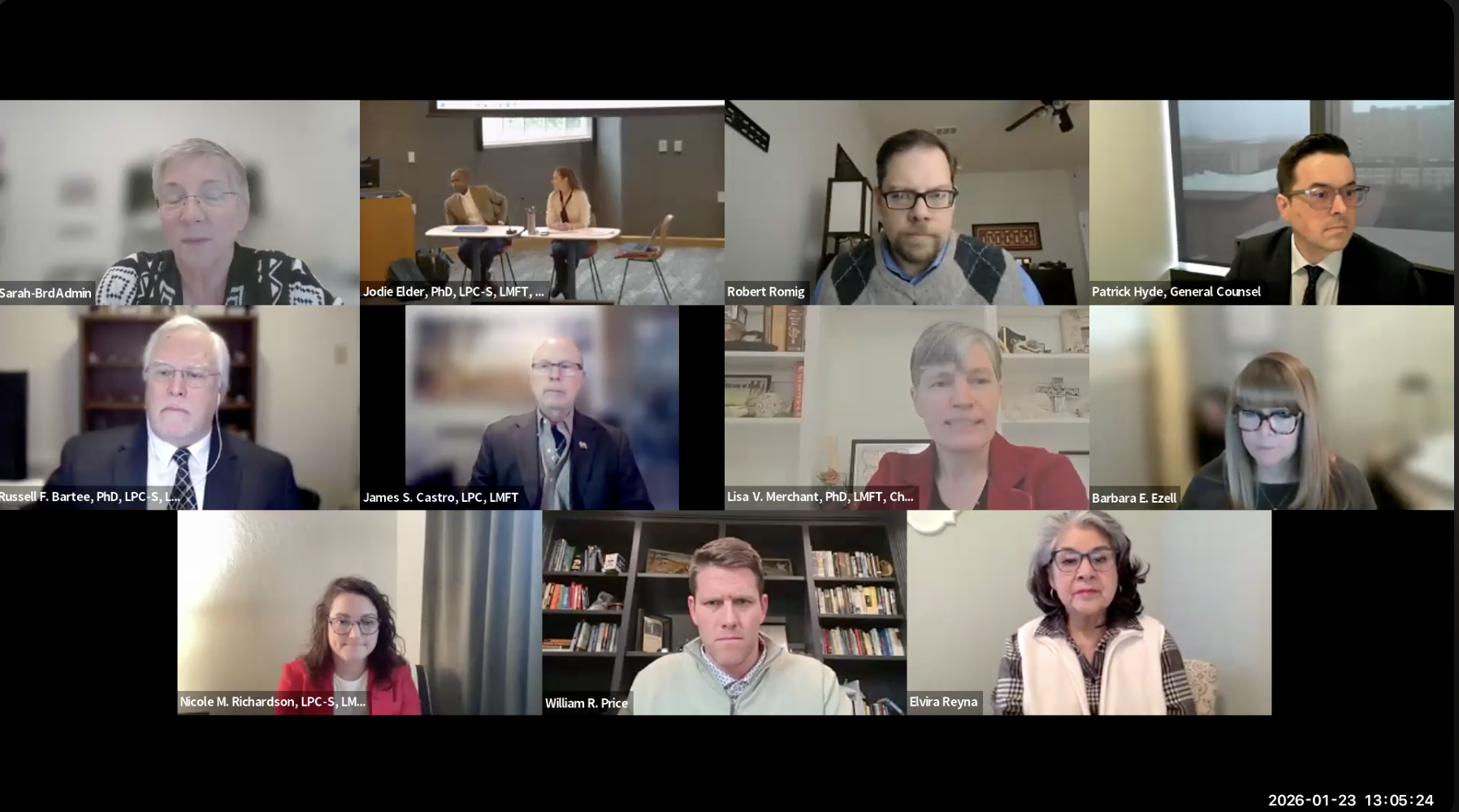
The January 23, 2026 Texas LMFT Board meeting:
Board members, staff, and stakeholders convened to discuss licensure updates, policy developments, and key regulatory priorities impacting Texas LMFTs.
January 2026 Texas LMFT Board Meeting Recap: What LMFTs Need to Know
The Texas State Board of Examiners of Marriage and Family Therapists convened on January 23, 2026 to address licensure updates, supervision data, enforcement processes, and emerging practice considerations affecting LMFTs across Texas.
While portions of the meeting focused on routine operations, several agenda items carry meaningful implications for licensees, supervisors, associates, and applicants. Below is a streamlined recap of the most relevant developments.
📌
Board Housekeeping
The April Board meeting was rescheduled to May 29, 2026 due to the TAMFT Annual Conference.
Board leadership continues statewide ethics and regulatory presentations.
Stakeholder engagement remains an ongoing priority.
In Memoriam
The Board honored the passing of Dr. Weayman Henson, former Presiding Officer and longtime advocate for the MFT profession.
Public Comment Themes
Counting Practicum Hours Toward Licensure
Board leadership reiterated:
• Certain graduate practicum hours may no longer count toward licensure.
• This phase-out aligns with statutory requirements.
• Individuals entering programs after September 1, 2025 will not qualify.
Early Hour Calculation Requests
The Board addressed recurring requests from applicants asking whether supervised experience hours can be pre-calculated or “pre-approved” before submitting a full licensure application.
To clarify, this question relates to post-graduate supervised experience completed under an LMFT-Associate license, not graduate practicum or internship hours.
Applicants nearing completion often ask whether staff can review their documentation in advance and confirm that hours will qualify before they apply. Board leadership clarified this is not operationally possible because:
• Experience hours are evaluated under the rules in effect at the time of application, not when hours were earned
• Rules may change between hour accrual and application submission
• Pre-calculations could create reliance on determinations that later become inaccurate
• Staff must review the full application packet, including supervision structure, setting eligibility, and documentation compliance
In practice, associates cannot receive a binding determination about whether hours will count until they formally apply and undergo standard licensure review.
Rulemaking Updates
Rules Effective November 9, 2025
The following rule changes are already in effect:
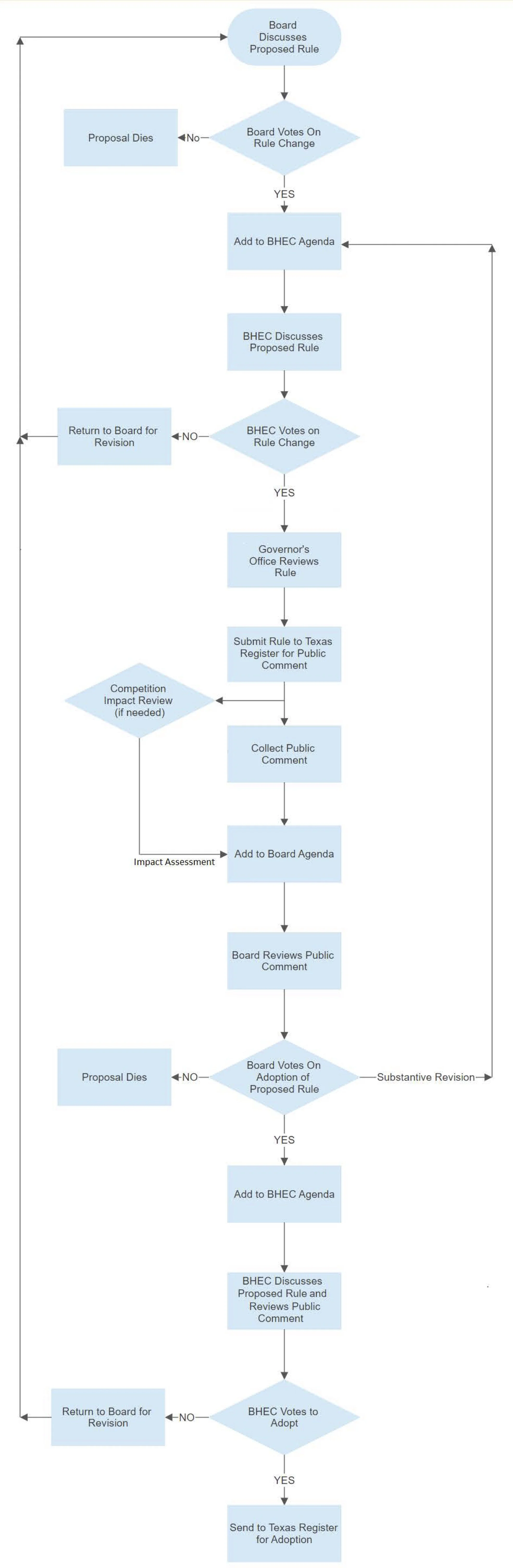
Unfamiliar with the BHEC Rulemaking Process? Here’s a map that delineates the process. Source: https://bhec.texas.gov/wp-content/uploads/2023/03/BHEC-Rulemaking-Process-Map-20230327.pdf
1. §801.44 Relationships with Clients – requires a licensee, who provides services to a client who concurrently receives services from another provider, to seek consent from the client to contact the other provider and to strive to establish a collaborative relationship with that provider.
2. §801.142 Supervised Clinical Experience Requirements and Conditions – requires an LMFT Associate, who becomes the subject of a complaint, to notify their supervisor of the complaint; clarifies an Associate must file a Supervisory Agreement Form with the Council for each supervisor; and requires an Associate, who receives a remediation plan, to share a copy of that plan with any other current and future supervisors.
3. §801.143 Supervisor Requirements – clarifies that a supervisor may share a copy of a remediation plan with any other supervisor of the LMFT Associate as well as the actions that a licensee must take upon the loss of supervisor status, either through a specified disciplinary action or a lapse in active licensure.
4. §882.1 Application Process – standardizes the expiration of incomplete license applications at 180 days from the date of receipt.
5. §882.2 General Application File Requirements – specifies that calculation of time periods for licensed experience shall begin when the relevant license is issued.
6. §882.21 License Statuses – allows licensees with a delinquent license to convert that license into inactive status.
Adopted Rules
Following the public comment period (with no public comments received), the Board adopted the following rules unanimously. These now return to BHEC for final adoption vote:
1. §801.2 Definitions – removes the term “regionally” to expand the category of acceptable accrediting agencies to include regional, national, and institutional accrediting bodies, as long as they are recognized by CHEA, THECB, or the U.S. Department of Education; and adds the recently created “temporary” license to the definition of license.
2. §801.57 Child Custody Evaluations – conforms the rule to the statutory changes made to Sections 107.104 and 107.112 of the Family Code by H.B. 2340 from the 89th Legislature, Regular Session (2025).
3. §801.112 General Academic Requirements – removes the term “regionally” to expand the category of acceptable accrediting agencies to include regional, national, and institutional accrediting bodies, as long as they are recognized by CHEA, THECB, or the U.S. Department of Education and standardizes the requirement that all courses must receive a passing grade and be credited on an applicant’s transcript, removing the requirement that some courses receive a “B” letter grade.
4. §801.113 Academic Requirements – removes the term “regionally” to expand the category of acceptable accrediting agencies to include regional, national, and institutional accrediting bodies, as long as they are recognized by CHEA, THECB, or the U.S. Department of Education.
5. §801.204 Licensing of Military Service Members, Military Veterans, and Military Spouses – aligns the Council's rules with changes made to Texas Occupations Code Chapter 55 by the 89th Legislature regarding licensing of military service members, veterans, and spouses.
Newly Proposed Rules
There were no newly proposed rules at this meeting.
Board Reports & Committee Updates
Board Chair Report
The Board Chair shared brief updates, noting that many priority initiatives were already captured within committee work. The Chair highlighted ongoing operational improvements, including the transition from full meeting minutes to concise meeting briefs with timestamps — a move intended to increase efficiency while preserving transparency and decision tracking.
BHEC Delegate Report
Board delegates provided updates from the Executive Council level, including regulatory and cross-disciplinary initiatives impacting all license types. Key updates included the following:
Emerging Practices & Technology Guidance: The Council approved publication of guidance related to new and emerging clinical practices and technologies. This document is now available through the Council website and reflects early efforts to address evolving clinical modalities, clinical decision support tools, and technology-assisted services.
Ketamine-Assisted Psychotherapy Listening Session: A formal listening session was held to gather stakeholder input regarding ketamine-assisted psychotherapy in Texas. Discussion focused on:
• Medical safety considerations
• Scope of practice boundaries
• Whether administration may constitute the unlicensed practice of medicine
No regulatory determinations have been issued. Any future rulemaking would involve coordination with the Texas Medical Board, Board of Nursing, and Board of Pharmacy.
Practice Monitoring Guidance: A guidance document developed to support practice monitors was reviewed. The Council declined public publication. Instead, the document will be used internally to support staff and licensees serving in monitoring roles.
Upcoming Rule Review: The Council is preparing for a tri-board rule review process. This review will be distinct from the recent four-year rule review cycle and will focus on cross-profession regulatory alignment.
Enforcement Process & ISC Rule Discussion: A significant policy discussion centered on proposed rule revisions affecting Informal Settlement Conferences (ISCs), which are early-stage complaint resolution meetings within the enforcement process.
Why the change is being considered:
• Complaint volume increased from approximately 500 to 800 cases
• Some boards manage significantly higher caseloads
• LMFT complaints remain comparatively low
What the proposal would do:
• Allow staff-led ISCs for administrative violations
• Retain board involvement for ethical and clinical issues
• Allow escalation when professional concerns arise
Important clarification: ISCs are informal resolution meetings, not final disciplinary determinations. Final outcomes occur through board and Council review.
In addition, the Board discussed re-election or replacement of its professional member delegate per Texas Occupations Code §507.051 and 22 TAC §881.4.
Board Administrator & Staff Report
Administrative staff provided operational, licensing, and compliance updates:
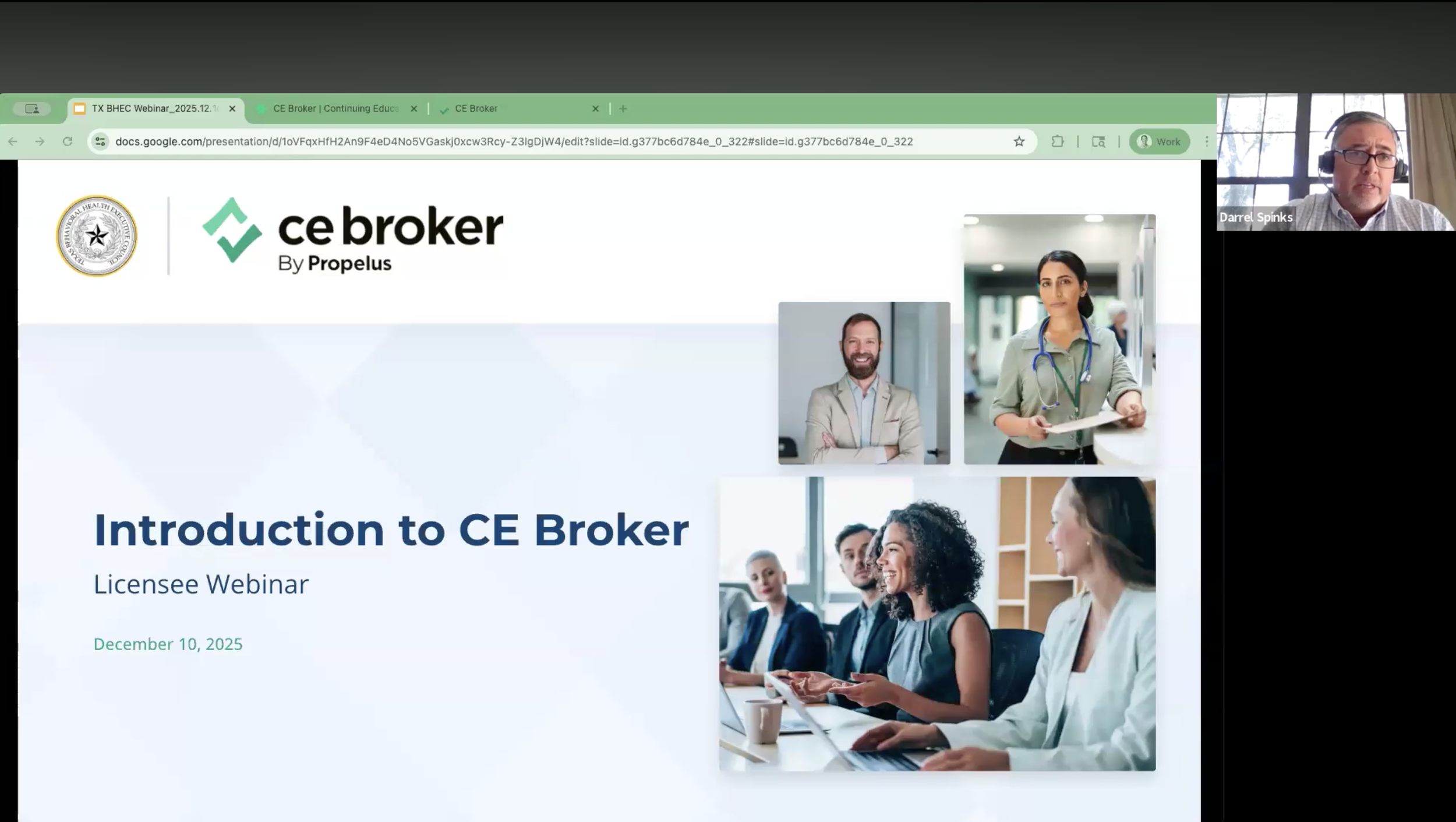
CE reporting has changed for all BHEC licensees. As of January 1, 2026, all continuing education must be tracked and reported through CE Broker. Learn more in our previous blog for a deeper dive into navigating the platform.
CE Broker Implementation
The continuing education reporting rule requiring use of CE Broker is now fully in effect.
Key implementation notes:
Licensees must report CE hours through CE Broker to renew.
Demonstration webinars, transcripts, and tutorials are available.
A help desk is accessible directly within the platform.
Early rollout observations:
Registration numbers are increasing steadily, though many licensees are waiting until renewal periods.
Duplicate license numbers across boards caused minor confusion but no functional issues.
Some licensees reported difficulty uploading documentation — an expected learning curve.
Staff will track:
Monthly registration rates
Renewal denials related to CE reporting
Workforce & Strategic Surveys: Leadership listening sessions and workforce data collection efforts remain active.
Committee Reports
Ethics Committee
The Ethics Committee reviewed 11 completed cases:
• 1 Warning Letter
• 3 Reprimands
• 6 Dismissals
• 1 Probated Suspension
All decisions were unanimously affirmed.
Supervision Workforce Survey — Preliminary Findings
Survey Overview
Dr. Merchant presented preliminary findings from the Board’s recent supervision workforce survey, offering background on the study’s development, methodology, and early results. The presentation was followed by Board discussion exploring supervision effectiveness, cost dynamics, and potential rule or policy implications.
Background & Purpose
The survey was developed in response to emerging questions and national conversations about post-graduate supervision requirements.
Key drivers included:
Reports of supervisee exploitation and financial strain
Concerns about supervision cost as a barrier to licensure
National discourse questioning whether supervision hours are necessary
Questions about preparedness for independent practice
Interest in identifying insufficient or harmful supervision trends
The Board sought to better understand supervisee experiences and evaluate whether current supervision rules adequately protect associates and the public.
Methodology Snapshot
177 participants who completed supervision within the past five years
Approximately 60+ survey questions
Mixed format including forced choice, Likert scale, and open response
Explored education, supervision structure, cost, preparedness, and satisfaction
Included measures assessing insufficient and harmful supervision
Despite survey length, average completion time was approximately 20 minutes.
Key Findings
Graduate education alone is insufficient preparation
• Only about 1% of respondents felt their master’s program fully prepared them across all measured competencies
• Preparedness increased significantly over the course of supervision
• By two years, nearly half felt mostly or fully prepared for independent practice
Supervision adds measurable professional readiness
• Findings support supervision as a meaningful competency-building phase
• Reinforces the role of post-graduate oversight in public protection
Cost is a burden, but generally viewed as reasonable
• Average supervision cost reported: $50/hour
• Only ~10–11% viewed costs as unreasonable
• Even higher-fee supervisees often still perceived value
Perceived value decreased at higher price tiers
• At $75–$100/hour+, supervisees reported lower perceived value
• Some paid more for supervision than they earned per clinical hour
Harmful or insufficient supervision rates appear low
• Preliminary analysis suggests low incidence
• Further data review is ongoing
Recent rule changes received affirmation
• Six-person group supervision cap aligned with respondent preferences
• No meaningful difference reported between in-person, video, or phone supervision
Board Discussion Highlights
Supervision length
• Some respondents suggested reducing supervision duration
• Board clarified 24 months is statutory, not adjustable by rule
Supervisor development
• Members emphasized strengthening supervisor training
• Interest in enhancing mentorship quality, not just hour tracking
Guidance tools
• Survey competency checklists may inform supervision tools
• Could help supervisors structure training
• Could help associates assess adequacy of supervision
Supervisor survey forthcoming
• Next phase will survey supervisors directly
• Goal launch: Spring 2026
• Comparative analysis expected
Economic realities
• Discussion acknowledged income vs supervision fee imbalance
• However, fee caps fall outside Board authority
Future policy use
• Data may inform rulemaking, guidance documents, or training standards
• Potential benchmarking studies may occur over time
Process Enhancements Discussed
• Increased use of peer consultation as a remedial measure
• Authority to restrict practice with specific populations when warranted
Supervisor Accountability Reminder
Supervisors were reminded to:
• Ensure associates do not practice before approval
• Review marketing materials for accuracy and compliance
• Distinguish coaching vs therapy roles clearly
Licensing Standards Committee
Discussion primarily centered around ongoing exploration of:
Appropriate clinical hour thresholds
Competency indicators for independent practice
Review of acceptable documentation for out-of-state applicants
Outreach Committee
Updates focused on supervision guidance resources, stakeholder education, and compliance transparency initiatives. See the sidebar for the detailed Supervision Workforce Survey preliminary findings.
Professional Development Committee
Radical CE Rule Reform Proposal
The Board reviewed a proposed continuing education overhaul designed to simplify compliance.
Key concepts include:
Removal of the 50% provider rule
Expansion of self-study hours
Greater flexibility in CE formats
Jurisprudence Exam Debate
The Board received updates regarding the jurisprudence exam vendor and exam administration.
Discussion included:
• Exam structure and delivery
• Content scope
• Potential requirement updates
No final action was taken.
Discussion emerged around whether to require the jurisprudence exam for all renewals.
Considerations included:
Pros
Reinforces rule literacy
Addresses regulatory changes
Cons
Added cost burden
Limited evidence it reduces complaints
No final action was taken, but broader stakeholder input is expected.
Rules Committee
The Board discussed the current definition of technology-assisted services as being too narrow (primarily focused on telehealth). Future revisions may include AI-assisted clinical tools and merging digital practice modalities.
Enforcement Case Highlight & Future Rulemaking Consideration
The Board reviewed a State Office of Administrative Hearings (SOAH) proposal related to a licensure application denial involving degree eligibility. The case centered on whether the applicant’s graduate degree qualified as coming from a “related mental health field” under current LMFT education rules. After deliberation, the Board voted to adopt the Administrative Law Judge’s findings, upholding the denial.
Discussion following the case raised broader rule clarity concerns, with members noting that applicants may be confused by degree titles that appear behaviorally adjacent but do not meet curricular equivalency standards. The LPC Board’s rules were referenced as an example of more explicit language identifying non-qualifying fields, including sociology, education, administration, dance therapy, and theology. The Board directed the Rules Committee to explore whether similar clarifying language should be considered for LMFT rules. No rule changes were proposed at this time, but the issue has been formally flagged for future review.
Final Takeaways
Themes emerging from this meeting include:
• Regulatory modernization and operational streamlining
• Ongoing refinement of licensure pathways and documentation standards
• Continued focus on supervision transparency, quality, and accessibility
• Increased attention to technology governance and emerging practice boundaries
• Enforcement process evolution in response to growing complaint volume across boards
Stay Connected with WisePractice
For ongoing board recaps, ethics updates, and supervision policy analysis, stay tuned to the Collective Wisdom Blog.
Subscribe to the WisePractice newsletter for grounded, practical guidance — translating board decisions into real-world clinical and supervisory practice.

Questions? Feedback? Topics you'd like us to cover in 2026? Let us know in the comments.
Guided by Wisdom. Rooted in Practice. Grown with Passion.
A Quick Disclaimer (Because It Matters)
This recap is for informational purposes only and reflects a summary interpretation of the January 23, 2026 LMFT Board meeting. It is not an official transcript or legal directive. Licensees should review statutes, administrative code, and formal board guidance directly for regulatory compliance.