
January 2026 Texas LPC Board Meeting Recap: What LPCs Need to Know
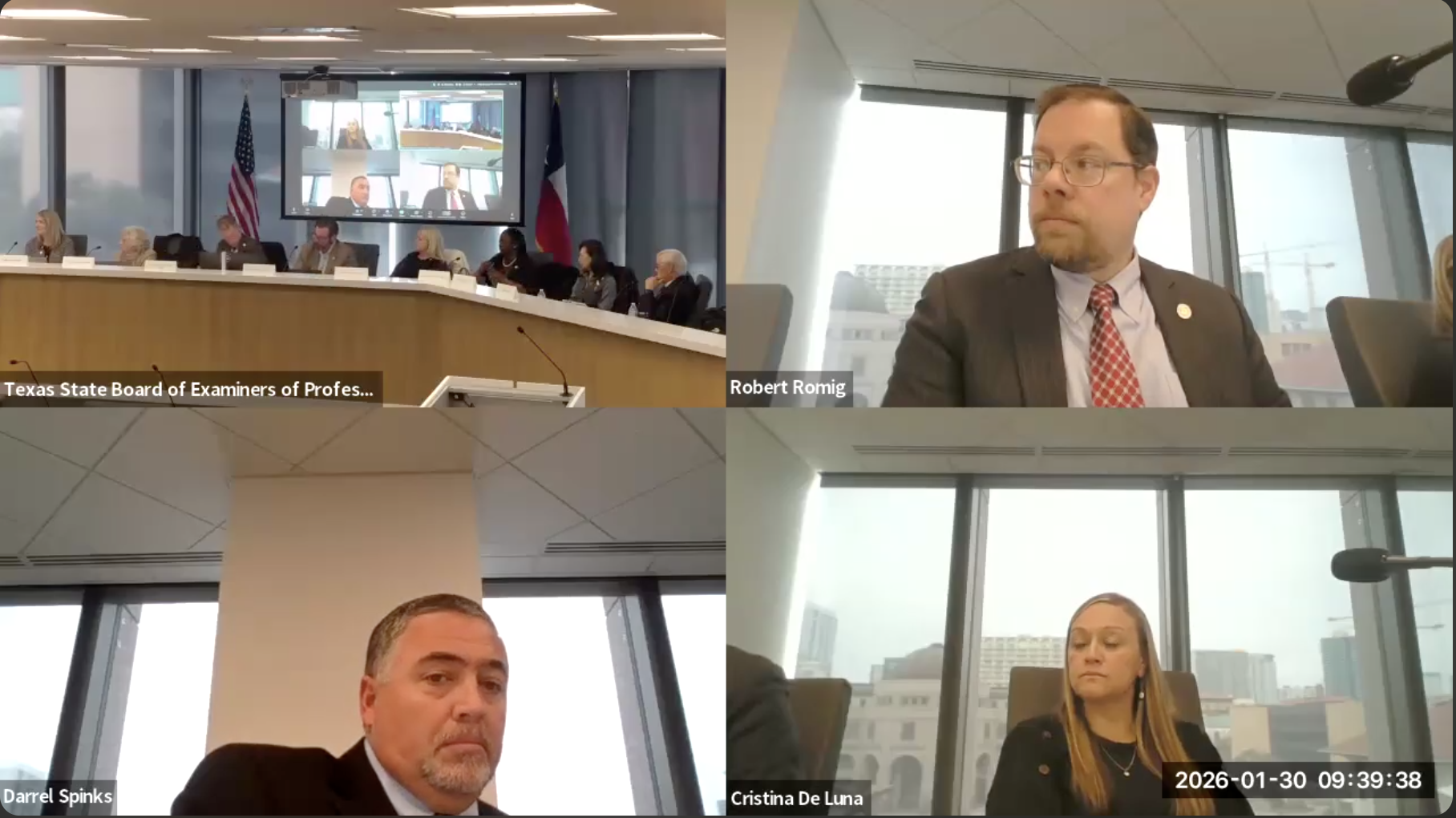
The January 30, 2026 Texas LPC Board meeting:
Board members, staff, and stakeholders convened to discuss licensure updates, policy developments, and key regulatory priorities impacting Texas LPCs.
The Texas LPC Board’s January 30, 2026 meeting focused on three big themes: public feedback on CE Broker and renewal readiness, a board-level response to rising complaint volume (including major structural changes to how Informal Settlement Conferences are staffed), and practical compliance reminders that directly impact associates, supervisors, and license renewal timelines.
Below is a recap of what happened, what it means, and what to do next.
Public comment highlights: CE Broker, legal uncertainty, and supervision in the real world
CE Broker usability concerns (renewal anxiety is real)
A practicing LPC-S shared detailed frustrations with CE Broker’s data entry fields, especially when entering conference CEs that do not clearly list individual presenters for each breakout. Key concerns included:
The platform feels not user friendly and lacks an accessible tutorial.
It is not always clear what to enter for “speaker” and related fields.
After entry and uploads, the system does not clearly display an “approved credit total” in a way that reassures licensees ahead of renewal.
A direct question was raised about whether there will be “grace” for early renewers navigating a new system.
→ Board response: Staff requested the feedback be emailed to leadership for follow up with CE Broker and acknowledged the usability issues. Later in the meeting, staff clarified a critical point (see CE Broker section below): there can be flexibility in how you enter information, but not in whether the system shows you complete before renewal.
Attorney General opinion request and “health care provider” classification
A public commenter referenced the pending request for an AG opinion on whether BHEC licensees are considered health care providers, and flagged potential downstream consequences depending on how that opinion lands.
→ Board stance (as reflected later in discussion): The board emphasized a measured approach: stay informed on high-impact legal developments, but avoid building rule responses until there is something concrete within the board’s authority to act on.
Supervision and AI is already here
An LPC-S noted that questions about AI use in documentation and clinical practice are already showing up in supervision settings, and emphasized the need for current, ethics-aligned training grounded in board expectations.
→ Board note: AI remained on the board’s radar as an ongoing discussion topic (and was referenced as an area already on the agenda in broader rule discussions).
Board governance changes: committees restructured and a major shift in enforcement workflow
Committee restructuring
The Chair announced committee changes intended to better match current workload realities:
Professional Development Committee and Counseling Compact Committee moved to ad hoc status.
Remaining standing committees were structured with three members each:
Rules Committee: Dr. Janie Stubblefield (Chair), Dr. Christopher Taylor, and Steven Hallbauer
Application and Supervision Committee: Dr. Bradley (Chair), Corey Rose, and Alisa Chan
Complaints Committee: Dr. Muna Amuna (Chair), Brian Eevee, and Nadia Stewart
The headline change: expanding ISC participation to all board members
The board spent significant time discussing an increase in complaint volume and the operational strain it creates. The Chair described a trend emerging over the last couple of years, with particular concern that the complaint rate has been rising steadily.
Operational change: The board is expanding participation in Informal Settlement Conferences (ISCs) beyond the complaints committee, making all board members available for ISC participation.
Safeguards emphasized:
Public members will not be assigned cases requiring nuanced clinical judgment about standard of care.
Staff may assign multiple board members to an ISC when appropriate.
The board repeatedly emphasized reliance on the penalty matrix to support consistency in outcomes.
→ WisePractice Takeaway: ISCs are a key bottleneck point in complex enforcement cases. Broadening the pool of board members aims to reduce scheduling logjams and move serious cases more efficiently, while protecting fairness and consistency.
Discussion points the board raised (and what licensees should hear in it)
Are these complaints more “frivolous”? Staff noted that the percentage of cases resulting in discipline has not meaningfully changed yet, suggesting the increase is not simply low-quality complaints. They also noted timing: complaint resolution can take many months, so shifts in outcomes may lag.
Who is filing complaints? The board acknowledged that complainants can include clients, family members, third parties, colleagues, supervisors, and anonymous sources. While the board does not currently “classify” complainants in a way that is easily reportable, members discussed whether improved tracking could help identify patterns.
What is staff already dismissing quickly? Staff walked through the early screening process and emphasized that many matters are dismissed very early when there is no jurisdiction or no viable allegation.
Consistency concerns: Board members specifically discussed the risk of perceived “judge shopping.” Training and process supports were discussed as a way to reduce variability, anchored by the penalty matrix.
→ Notable invitations:
BHEC leadership welcomed the public to share comments on the ISC discussion. You can play the full discussion back here, if you’d like: Listen in from the time marker 24 min to 1 hour 07 min.
BHEC leadership explicitly asked the public to share ideas about why complaint volume is rising, and encouraged stakeholders to submit suggestions.
Compliance clarification: Texas Family Code mandatory reporting timelines
The board provided a focused legal clarification on Texas Family Code §261.101, emphasizing that:
Mandatory reporting duties apply to every Texan, and professionals have an elevated requirement.
Professionals must report no later than 24 hours after first having reasonable cause to believe abuse or neglect occurred.
The duty cannot be delegated as a defense for failure to report.
Reporting is also required when an adult discloses past childhood abuse if there is reasonable cause to believe another child, elderly person, or person with a disability may currently be at risk, even if the original victim is now an adult.
Failure to report suspected abuse or neglect can carry criminal penalties under Texas Family Code Chapter 261; however, professionals are granted legal immunity when reporting in good faith (meaning unless a report is knowingly false). Therefore, the guiding standard is to report when reasonable cause exists.
Anonymous complaints are no longer accepted.
→ WisePractice Takeaway: This was framed as a legal duty, not a clinical preference. When in doubt, consult the Texas Family Code §261.101 directly, and consult with legal/ethical supports such as your malpractice insurance. Remember: clinicians are not investigators, and the standard is “reasonable cause,” not proof.
Key licensing and operations updates you should not miss
→ Application deadline rule now in effect: 180-day limit
Staff highlighted BHEC rule 82.1: applications for initial licensure, upgrades, and reinstatements are open only 180 days. If the application expires, the applicant must reapply and pay a new fee.
→ Associate upgrades: process must be initiated online
Staff noted a recurring issue: supervised experience forms are being emailed without the associate initiating the upgrade process. Associates must start the upgrade application online to trigger the workflow.
→ Supervision records: sign more frequently
Staff encouraged supervisors and associates to reconcile hours more frequently, noting an increase in disagreement about supervision/experience totals.
→ Supervisor application tip: upload and attach the certificate
A simple operational issue is causing delays: applicants upload the supervisor course certificate but do not click “attach.” This creates deficiencies and slows approval timelines.
→ Exams:
Spanish NCE availability: The board shared that the Spanish NCE is expected to become available for Texas applicants soon, and Spanish NCMHCE is in progress but without a firm timeline.
Jurisprudence Exam: Feedback remains largely positive, with the exam continuing to function as a regulatory refresher. Recent administrative updates include question reviews and revisions aligned with rule changes, supported by BHEC ombudsman staff to ensure accuracy and clarity moving forward.
CE Broker: the board’s message was clear
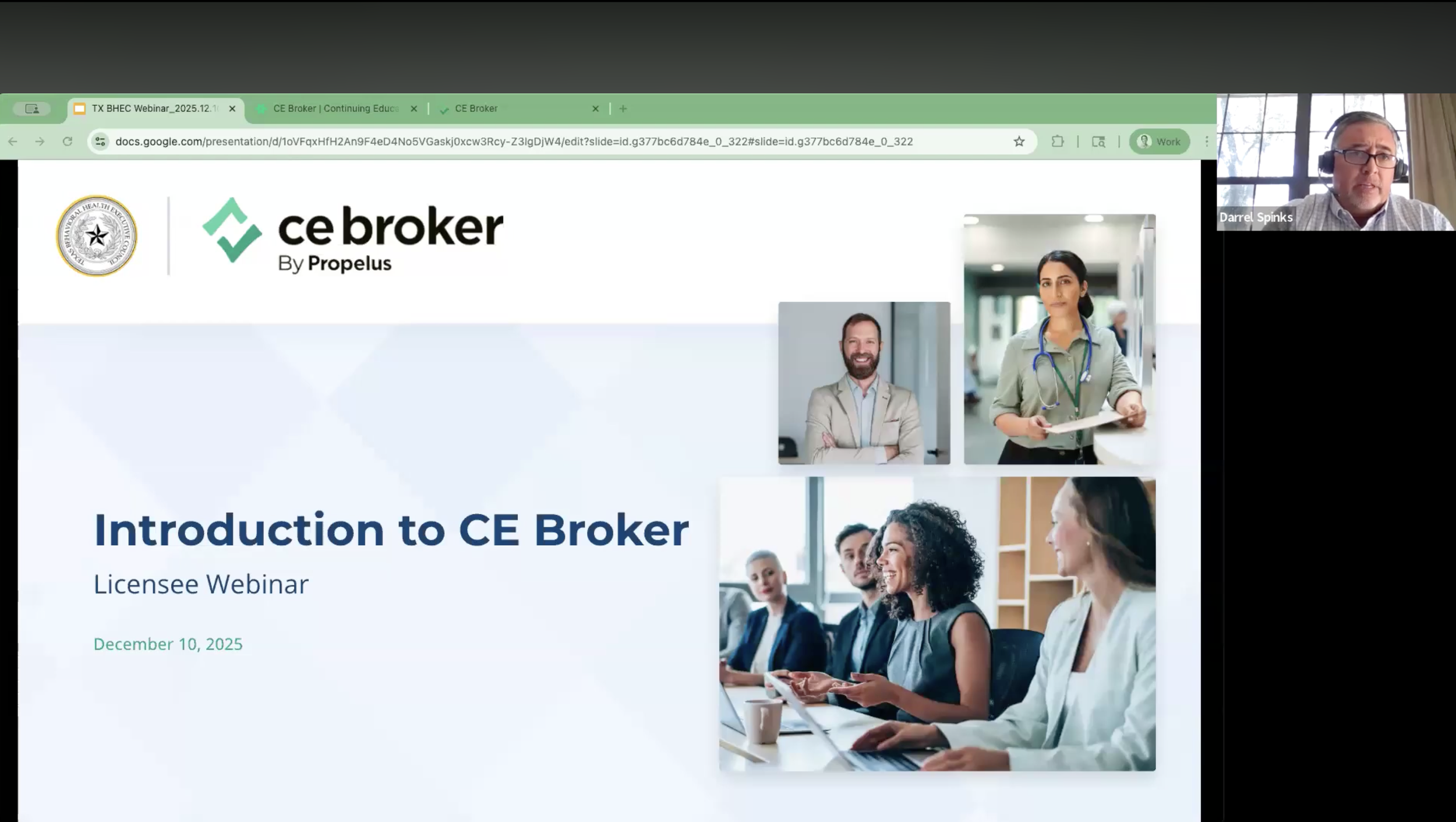
CE reporting has changed for all BHEC licensees. As of January 1, 2026, all continuing education must be tracked and reported through CE Broker. Learn more in our previous blog for a deeper dive into navigating the platform.
Staff addressed CE Broker concerns directly with a practical, compliance-first message:
Do your best with data entry. Staff are not trying to “grade” you on the speaker name field or whether you pick webinar vs online vs in-person perfectly.
You can enter conferences as one combined entry or split entries by category. Both are acceptable.
The non-negotiable issue is completion: you must have the system reflect completion (seeing the “green check” for requirements being met) before renewal.
→ Bottom line: There may be grace for messy entries, but there is no grace for missing completion status when your renewal date passes. If the system shows incomplete, your license can become delinquent and late fees apply.
Board action items and votes
→ BHEC representative election
The board unanimously reappointed Dr. Christopher Taylor as the LPC Board’s professional member delegate to the Texas Behavioral Health Executive Council.
→ Enforcement: SOAH matter and revocation recommendation
The board reviewed a contested case remanded from the State Office of Administrative Hearings (SOAH) involving allegations including falsification of notes and non-cooperation. The board voted to support a recommendation of revocation.
→ Rulemaking: adoption votes
The board voted to recommend adoption of:
§681.53 Child Custody Evaluation, Adoption Evaluation, and Evaluations in Contested Adoptions
§681.114 Licensing of Military Service Members, Military Veterans, and Military Spouses
These were framed as “must do” updates tied to legislative direction and proceed next to the BHEC level for final adoption.
→ Also noted: Prior rule items related to LPC-Associate licensure and supervisor requirements (referenced by rule numbers in the meeting) were previously withdrawn for additional discussion and remain in a “pending” posture.
Other notable signals: Compact, surveys, and workforce data
→ Counseling Compact status
Staff reiterated: Texas cannot join the counseling compact without legislation, and the next legislative session begins in January 2027. The board cannot lobby, so licensees and associations drive that work.
→ Surveys: 600+ associate responses and workforce survey push
The LPC associate survey received 600+ responses and will be reviewed by the Rules Committee.
Leadership strongly encouraged completion of the workforce survey, emphasizing it is actively used to respond to legislative and stakeholder questions.
What this means for Texas LPCs and supervisors
→ If you are renewing soon
Set up CE Broker now, not later.
Aim for “good enough” data entry, but do not gamble with completion status near your renewal deadline.
→ If you supervise associates
Tighten your supervision documentation rhythm. More frequent reconciliation protects both parties. We recommend keeping a mutual hours log that is reviewed by supervisor and supervisee each supervision session.
Expect ongoing rule discussion about supervision calculation expectations (the board referenced the “four hours per month” requirement as an area being clarified and potentially better outlined).
→ If you care about enforcement trends
The board is naming complaint volume as a real system pressure and is actively redesigning workflow.
Expect further updates after the February 17, 2026 BHEC meeting, and after the board formalizes training and scheduling logistics for ISC participation.
→ Key dates to track
February 17, 2026: Texas Behavioral Health Executive Council meeting (ISC process discussion noted as active at that level)
March 5 to 6, 2026: TAACES Midwinter Conference (LPC Board update featured March 5)
January 2027: Next Texas legislative session (compact legislation timing)
Final Wrap-Up
Key Takeaways for Clinicians
→ Complaint trends and enforcement processes: Complaint volume is rising, and the board is actively restructuring how cases are reviewed to improve efficiency and response time. Expanded ISC participation and deeper data analysis are underway — but no immediate enforcement rule changes were adopted at this meeting.
→ Supervisors and Associates: Supervision documentation, upgrade processes, and hour tracking remain under close operational review. The board is analyzing survey data and may clarify expectations (including supervision calculation standards) in future rule discussions.
→ License renewal readiness: CE Broker is fully in effect. While staff signaled flexibility around how CE data is entered, there is no flexibility on completion status at renewal. If your CE record is not verified before your expiration date, your license can become delinquent.
→ Mandatory reporting: The board clarified the 24-hour reporting duty for professionals under Texas Family Code. When reasonable cause exists, reporting is a legal obligation — not discretionary.
→ Rulemaking and legislation: Recent rule adoptions largely reflected legislative directives (custody evaluations and military licensure pathways). Broader supervision and licensure rules remain under review, not finalized.
Stay Connected with WisePractice
For ongoing board recaps, ethics updates, and supervision policy analysis, stay tuned to the Collective Wisdom Blog.
Subscribe to the WisePractice newsletter for grounded, practical guidance — translating board decisions into real-world clinical and supervisory practice.

Questions? Topics you'd like us to cover in 2026? Let us know in the comments.
Guided by Wisdom. Rooted in Practice. Grown with Passion.
A Quick Disclaimer (Because It Matters)
This recap is intended for informational and educational purposes only and reflects a summary interpretation of the January 30, 2026 Texas State Board of Examiners of Professional Counselors meeting. It is not an official transcript, legal opinion, or regulatory directive. Licensees are responsible for reviewing board rules, statutes, and formal guidance directly through the Texas Behavioral Health Executive Council (BHEC) and the LPC Board. For specific legal, ethical, or licensure questions, consult the relevant statutes, administrative code, or qualified legal counsel.