
May 2026 Texas Psychology Board Meeting Recap: Key Updates
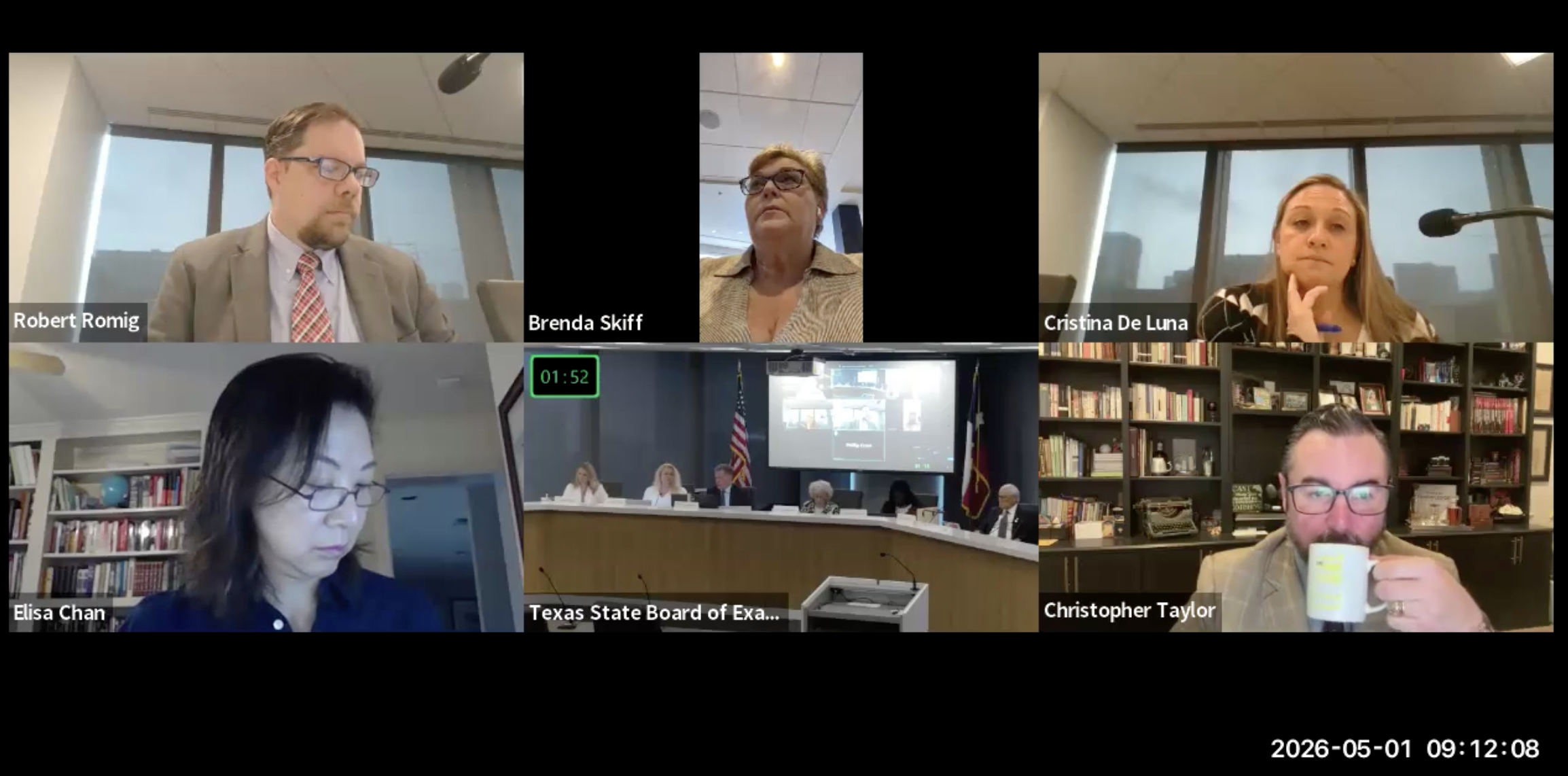
The May 7, 2026 Texas Psychology Board meeting:
Board members, staff, and stakeholders convened to discuss licensure updates, policy developments, and key regulatory priorities impacting Texas Psychologists.
The May 7, 2026 meeting of the Texas State Board of Examiners of Psychologists offered significant updates that could meaningfully shape the future of psychology licensure, professional standards, and regulatory oversight in Texas and beyond.
For licensed psychologists, trainees, supervisors, and behavioral health professionals watching broader BHEC developments, this meeting was particularly notable due to continued advancement of Texas’s proposed alternative psychology licensure examination, alongside important rulemaking and enforcement discussions.
Below is a breakdown of the most relevant updates.

Unfamiliar with the BHEC Rulemaking Process?
Here’s a map that delineates the process.
Source: https://bhec.texas.gov/wp-content/uploads/2023/03/BHEC-Rulemaking-Process-Map-20230327.pdf
The rulemaking process utilized by the Council is set out in 22 TAC 881.20.
Major Spotlight: Texas Continues Development of an Alternative Psychology Licensure Exam
Perhaps the most consequential agenda item was the Board’s continued movement toward designing a Texas-developed psychology licensure exam as a potential alternative to the Examination for Professional Practice in Psychology (EPPP).
Why this matters:
For years, psychologists nationwide have raised concerns regarding the EPPP’s:
High financial burden
Accessibility barriers
Relevance to actual clinical practice
Equity concerns
Overemphasis on theoretical versus applied competency
Texas appears to be taking these concerns seriously.
Stakeholder survey findings:
According to BHEC’s stakeholder survey of 847 psychology professionals:
59% of respondents with definitive opinions supported development of an alternative exam
Primary concerns with the current EPPP included:
Cost
Professional impact
Fairness
Content relevance
Content validity
Key priorities for the new exam:
Texas’s proposed model strongly emphasizes:
Applied clinical competency
Scenario-based and situational judgment items
Ethics and professional conduct
Cultural responsiveness
Accessibility through lower cost and remote options
Potential dual cut scores for supervised vs. independent practice
Notable implications:
If successfully developed, this exam could:
Expand licensure pathways
Reduce financial and logistical barriers
Increase professional mobility
Potentially influence national licensure standards
Important caveats:
Board materials also acknowledge:
Significant psychometric complexity
Need for legal defensibility
Interstate recognition challenges
Cost and sustainability questions
Security concerns with innovative testing formats
Bottom line:
Texas is not replacing the EPPP at this time, but it is actively exploring an additional route that may represent one of the most substantial licensure innovations in psychology in recent years.
Jurisprudence Exam Updates
The Board also reviewed updates to jurisprudence examination content and format.
Key themes:
Ongoing modernization
Focus on legal/ethical competency
Potential refinement for greater relevance to practice realities
Continued alignment with evolving board standards
While less headline-grabbing than the alternative licensure exam, jurisprudence revisions remain highly relevant for future applicants and supervisors preparing trainees.
Rulemaking: Scientific and Professional Judgments (§465.10)
The Board reviewed amendments related to “Basis for Scientific and Professional Judgments.”
Why this matters:
This rule addresses expectations that psychologists ground their professional activities in:
Established scientific knowledge
Competency
Ethical standards
Evidence-based practice
Potential broader implications:
Depending on implementation, this could further reinforce:
Accountability for pseudoscientific or unsupported interventions
Practice standards tied to evidence-informed care
Ethical obligations in assessment and intervention choices
For clinicians, supervisors, and educators, this may signal continued regulatory emphasis on scientific integrity.
Enforcement Trends: Complaints, Resolution, and Board Oversight
BHEC performance metrics continue to reveal both progress and system strain.
Key data:
140 complaints resolved in Q2
945 complaints pending across BHEC
Average complaint resolution time remains lengthy
Legal staffing shortages continue to impact timelines
Clinical takeaway:
While processing efficiency has improved in some areas, enforcement systems remain under pressure.
For licensees, this reinforces the importance of:
Documentation
Ethical compliance
Clear supervision practices
Risk management
Licensing and Processing Efficiency
The Board reported:
Faster average processing times for many license applications
Overall average processing time around 27 days
Ongoing efforts to improve staffing and administrative responsiveness
This is encouraging for applicants and supervisors navigating licensure pathways.
PSYPACT and Interstate Mobility
Texas continues to maintain strong involvement in PSYPACT developments.
Current landscape:
43 participating states
Over 16,000 active telepsychology authorizations
Continued growth nationally
Why this matters:
For psychologists interested in telehealth, interstate practice, and broader service reach, PSYPACT remains increasingly relevant.
WisePractice Clinical Perspective
From a broader systems lens, this meeting reflected several important trends:
1. Licensure reform is gaining momentum
Texas may be at the forefront of rethinking professional competency evaluation.
2. Accessibility and equity concerns are becoming central
Cost and fairness are no longer peripheral concerns—they are shaping policy.
3. Applied competence is increasingly prioritized
The profession appears to be shifting away from purely theoretical gatekeeping toward practical, ethical, real-world readiness.
4. Regulation continues to emphasize evidence-based practice
Scientific grounding and accountability remain central.
Final Thoughts
The May 2026 Psychology Board meeting was more than routine governance—it may represent an early chapter in broader professional reform.
For psychologists, supervisors, and mental health leaders, these developments warrant close attention.
If Texas successfully develops a defensible, accessible, and practice-relevant alternative licensure exam, it could have ripple effects far beyond state lines.
Stay Connected
At WisePractice Institute, we remain committed to helping clinicians and supervisors stay informed, ethically grounded, and prepared for evolving professional landscapes.
Regulatory literacy is clinical leadership.
As these developments continue, we encourage clinicians to remain engaged—not only as practitioners, but as stakeholders shaping the future of our professions.
For ongoing board recaps, ethics updates, and supervision policy analysis, stay tuned to the Collective Wisdom Blog.
Subscribe to the WisePractice newsletter for grounded, practical guidance — translating board decisions into real-world clinical and supervisory practice.

Questions? Topics you'd like us to cover in 2026? Let us know in the comments.
Guided by Wisdom. Rooted in Practice. Grown with Passion.
A Quick Disclaimer (Because It Matters)
This recap is intended for informational and educational purposes only and reflects a summary interpretation of the meeting. It is not an official transcript, legal opinion, or regulatory directive. Licensees are responsible for reviewing board rules, statutes, and formal guidance directly through the Texas Behavioral Health Executive Council (BHEC) and their respective Board(s). For specific legal, ethical, or licensure questions, consult the relevant statutes, administrative code, or qualified legal counsel.