
May 2026 Texas LMFT Board Meeting Recap: Supervision, Technology, AI, and Future Rule Changes
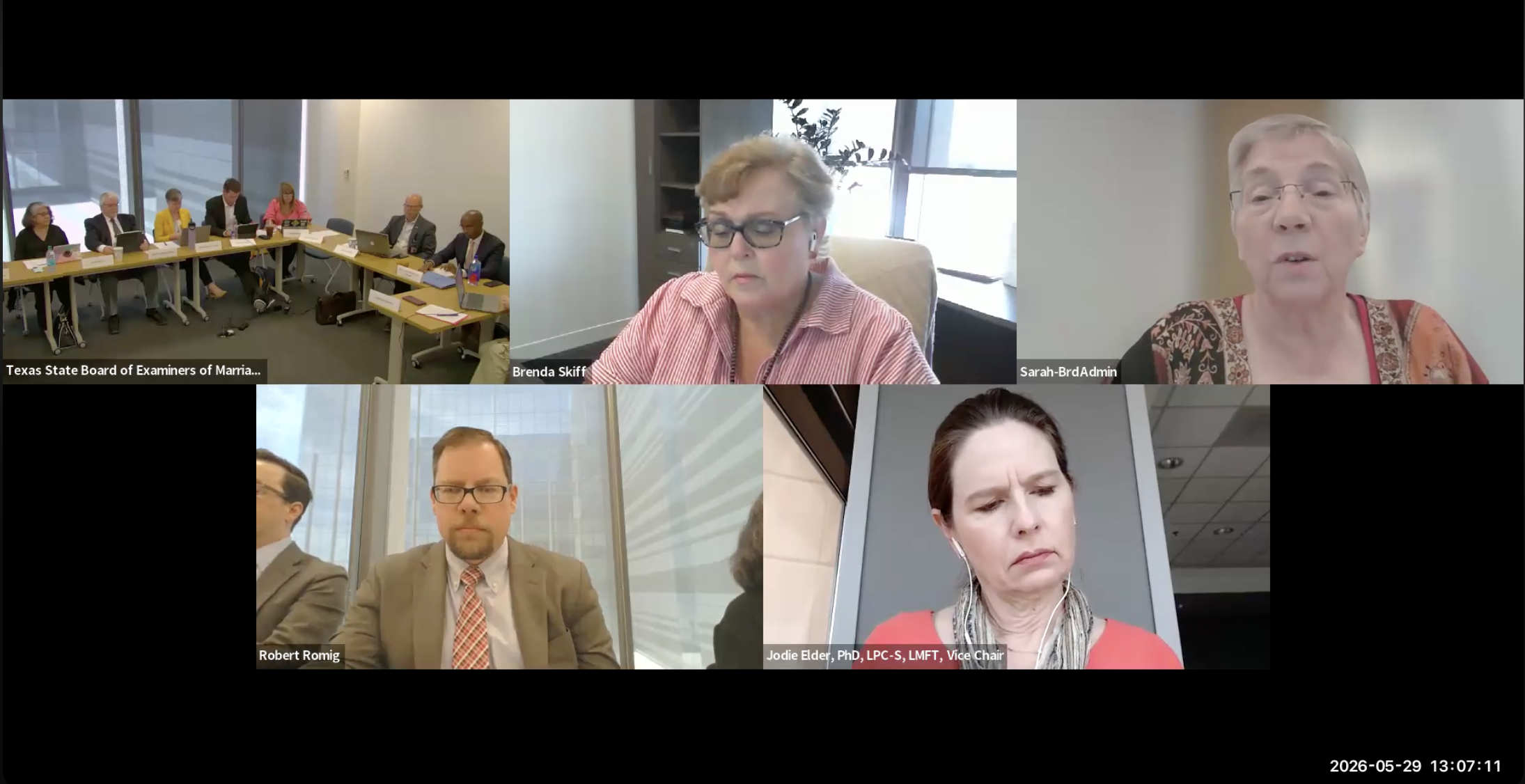
The May 29, 2026 Texas LMFT Board meeting:
Board members, staff, and stakeholders convened to discuss licensure updates, policy developments, and key regulatory priorities impacting Texas LMFTs.
Highlights from the May 29, 2026 Texas State Board of Examiners of Marriage and Family Therapists Meeting
The Texas State Board of Examiners of Marriage and Family Therapists (LMFT Board) met on May 29, 2026, to discuss a wide range of topics impacting LMFTs, LMFT Associates, supervisors, and future applicants. While the meeting did not include major rule adoptions, it offered valuable insight into where the Board is focusing its attention—including supervision quality, technology-assisted services, artificial intelligence, continuing education reform, and potential restructuring of Board operations.
Below are some of the key takeaways for Texas LMFTs.
Leadership Transition at the LMFT Board
The meeting marked an important leadership transition as Dr. Lisa Merchant concluded her service as Board Chair after more than five years in the role. Incoming Chair John Hampton expressed appreciation for Dr. Merchant's leadership, professionalism, and commitment to the profession. The transition appeared collaborative and thoughtful, with both emphasizing continuity and service to the profession.
CE Broker Update: Progress Continues Despite Ongoing Complaints

Haven’t heard of CE Broker yet or the new requirements for Texas licensure? No worries, we break it down for you. Read the blog here.
BHEC staff provided an update on the transition to CE Broker.
According to staff, the vast majority of licensees have successfully renewed through the system without needing assistance. Approximately half of licensees have now activated their accounts, and BHEC expects most professionals to have completed at least one renewal cycle through CE Broker by early 2027.
Staff acknowledged ongoing frustrations from some licensees but noted that new resources have been added, including:
Updated step-by-step guides
Additional support resources
A live customer service phone option through CE Broker for users logged into their accounts
While BHEC has seen a slight increase in delinquent renewals, staff indicated the increase appears relatively small compared to the overall number of monthly renewals.
LMFT Supervision Survey Results: What Associates Reported
One of the most substantive discussions centered around results from a recent supervision survey completed by LMFT Associates and recently licensed LMFTs.
A total of 247 individuals responded to the survey, providing valuable information about supervision experiences in Texas.
Master's Programs Are Not Fully Preparing New Clinicians
Only about 1% of respondents reported feeling completely prepared for all required clinical and ethical responsibilities immediately upon graduation.
However, after completing supervision, nearly half reported that supervision played a significant role in helping them develop competency across all required areas.
This finding reinforced the Board's long-standing position that supervision serves an essential developmental function beyond graduate education.
Supervision Is Expensive—but Viewed as Valuable
Although many respondents described supervision as a financial burden, most still viewed the investment as worthwhile.
Key findings included:
68% rated supervision as "very valuable"
Only 1% reported supervision as having no value
Those paying lower supervision fees generally reported greater satisfaction
Even many supervisees paying higher rates reported that the value received justified the cost
Concerns About Inadequate and Harmful Supervision
One of the more interesting findings involved supervisees' perceptions of supervision quality.
When asked directly whether they had experienced inadequate supervision:
Only 7% said yes.
However, when researchers examined responses across multiple indicators of supervision quality, the picture became more complex.
The survey suggested that many supervisees may not recognize when supervision is inadequate or potentially harmful. While only a small percentage described supervision as overtly harmful, larger percentages reported experiences involving at least some characteristics associated with inadequate supervision.
Potential Next Steps
Board members discussed several possible responses:
Conducting a complementary supervisor survey
Creating educational resources for supervisors and supervisees
Providing clearer guidance regarding harmful supervision practices
Offering more information about supervisory expectations and responsibilities
Increasing outreach through universities and professional organizations
Notably, Board members appeared more interested in education and outreach than new regulations at this stage.
Continuing Education Reform ("The Ambitious Plan")
The Board also revisited discussion of Dr. Merchant's proposal for broader continuing education reform—humorously rebranded during the meeting from the "Radical Plan" to the "Ambitious Plan."
Although no action was taken, Board members discussed:
Reducing unnecessary CE restrictions
Modernizing CE requirements
Creating greater flexibility for licensees
Aligning future proposals with other BHEC boards
Discussion suggested there is continued interest in exploring reforms, but likely with a lengthy implementation timeline and additional stakeholder input before any formal proposal moves forward.
Technology-Assisted Services Rule Revisions Continue
The Rules Committee reported ongoing work updating rules related to technology-assisted services.
Discussions included:
Updating terminology
Expanding definitions to reflect modern practice
Clarifying expectations regarding virtual services
Addressing supervision and experience requirements related to telehealth
One particularly interesting discussion involved the current requirement limiting the percentage of supervised experience hours that can be obtained through virtual practice.
Board members explored several questions:
How should the Board verify compliance?
How are other states handling similar requirements?
Should experience earned in other states be evaluated differently?
Does the current rule still make sense in an increasingly virtual practice environment?
No decisions were made, but the conversation suggests continued review of telehealth-related requirements may be forthcoming.
AI Is Officially on the Board's Radar
Artificial intelligence surfaced multiple times throughout the meeting.
Board members discussed:
The state's new AI-powered government chatbot ("SAM")
The growing use of AI within behavioral health professions
Challenges in obtaining research and data to guide future policy decisions
The possibility of future AI-related standards or guidance
While no formal AI rulemaking is currently underway, Board members clearly recognized that AI will likely become a significant regulatory issue over the next several years.
For LMFTs already experimenting with AI tools for documentation, practice management, or education, this is an area worth watching closely.
Committee Restructuring May Be Coming
The Board also discussed simplifying its committee structure.
Currently, the nine-member Board operates with five standing committees. Leadership proposed moving toward a smaller number of standing committees supplemented by ad hoc committees when needed.
Potential goals include:
Increasing efficiency
Reducing administrative burden
Allowing broader participation from Board members
Streamlining Informal Settlement Conference staffing
No final decisions were made, but an ad hoc committee was created to bring recommendations back at a future meeting.
AMFTRB Exam Handbook Controversy
The Board also received an update from representatives of the Association of Marital and Family Therapy Regulatory Boards (AMFTRB) regarding concerns raised earlier this year about inaccuracies in the 2026 candidate handbook used for the national licensing examination.
AMFTRB representatives explained that:
The exam itself remained valid and aligned with current content specifications.
The error involved publication of an outdated content outline in candidate materials.
Corrected materials were distributed once the issue was discovered.
Affected candidates were offered either a free retest or a full refund.
Board members questioned AMFTRB representatives about quality control measures and communication procedures moving forward.
Licensing Case Highlights
The Board considered a licensure appeal involving an out-of-state LMFT applicant whose disciplinary history prevented automatic qualification under existing reciprocity provisions.
After discussion, the Board approved licensure through a waiver process with conditions, including a practice monitor and a probationary period. The case generated thoughtful discussion about balancing public protection with rehabilitation and professional mobility.
Looking Ahead
While the May meeting did not produce major rule changes, it offered a clear picture of where the Board's attention is focused:
Supervision quality and education
Technology-assisted services
Continuing education modernization
Artificial intelligence
Committee and operational efficiency
Licensing portability
Several of these topics appear likely to return in future meetings, particularly technology-assisted services, supervision-related issues, and potential CE reforms.
The next LMFT Board meeting is currently scheduled for September 2026.
Stay Connected
At WisePractice Institute, we remain committed to helping clinicians and supervisors stay informed, ethically grounded, and prepared for evolving professional landscapes.
Regulatory literacy is clinical leadership.
As these developments continue, we encourage clinicians to remain engaged—not only as practitioners, but as stakeholders shaping the future of our professions.
For ongoing board recaps, ethics updates, and supervision policy analysis, stay tuned to the Collective Wisdom Blog.
Subscribe to the WisePractice newsletter for grounded, practical guidance — translating board decisions into real-world clinical and supervisory practice.

Questions? Topics you'd like us to cover in 2026? Let us know in the comments.
Guided by Wisdom. Rooted in Practice. Grown with Passion.
A Quick Disclaimer (Because It Matters)
This recap is intended for informational and educational purposes only and reflects a summary interpretation of the meeting. It is not an official transcript, legal opinion, or regulatory directive. Licensees are responsible for reviewing board rules, statutes, and formal guidance directly through the Texas Behavioral Health Executive Council (BHEC) and their respective Board(s). For specific legal, ethical, or licensure questions, consult the relevant statutes, administrative code, or qualified legal counsel.