

The February 17, 2026 Texas BHEC Board meeting:
Board members, staff, and stakeholders convened to discuss licensure updates, policy developments, and key regulatory priorities impacting Texas licensees.
The February 17 BHEC meeting covered a lot of ground—nearly three and a half hours of discussion touching on violence prevention efforts, disciplinary processes, licensing updates, and rule changes across multiple boards.
If you weren’t able to attend—or if you did but would appreciate help organizing the information or sharing it with colleagues or supervisees—this recap highlights the key discussions and practical takeaways for LPCs, LMFTs, psychologists, and social workers regulated by BHEC.
Key Takeaways for Texas Licensees
If you’re short on time, here are eleven key takeaways from the February 17 BHEC meeting:
Behavioral threat assessment teams may increasingly involve mental health professionals. DPS is actively recruiting, and CE credit is available for related training.
A future law may clarify confidentiality protections when participating in multidisciplinary safety teams.
Enforcement workload remains high, with more than 900 complaints pending.
CE Broker is now mandatory for license renewal as of January 1, 2026. Create your account if you haven't already.
A new school psychology retraining program was approved, creating an alternative pathway to LSSP licensure for working school professionals.
BHEC is exploring long-term development of a Texas psychology licensing exam, with the earliest potential implementation around 2029.
The Council denied a petition to change the structure of disciplinary review panels, but clarified that board members will continue to be involved in cases requiring professional judgment.
A Spanish-language social work exam remains a goal but faces significant financial and structural barriers.
If you are hesitant to file a complaint due to retaliation concerns, BHEC staff is available to discuss your options and may be able to assist.
Numerous rule updates were adopted across LPC, LMFT, psychology, and social work boards.
Future rulemaking may follow a more predictable annual schedule, with proposals in June and adoptions in October.
More detailed discussion of each item is outlined below.
Chairman's Report & Invited Testimony
Behavioral Threat Assessment & Mental Health Collaboration
The Council heard invited testimony from Major Sharon Jones of the Texas Department of Public Safety (DPS) regarding statewide Behavioral Threat Assessment and Management (BTAM) teams aimed at preventing targeted violence.
Key points:
Texas DPS is expanding behavioral threat assessment teams across the state.
Teams include law enforcement, schools, medical professionals, and mental health professionals.
The goal is early identification and intervention for individuals on a pathway to targeted violence.
DPS emphasized the importance of mental health professionals participating on these teams to provide clinical insight when evaluating individuals presenting concerning behaviors.
Major Jones shared multiple real-world examples of thwarted attacks in Texas, illustrating the direct impact of these teams on public safety.
Teams meet regularly (often monthly), with some meetings conducted via Zoom to accommodate rural participants. The time commitment was described as minimal for most participants.
DPS's annual behavioral threat assessment conference offers continuing education credit for mental health professionals. Training sessions offered by DPS also qualify for CE credit under the 50% rule as a governmental entity.
The Council directed staff to participate in shaping any proposed legislation and indicated willingness to send recruitment information to its listserv of approximately 125,000 licensees.
Legislative proposal discussed:
DPS indicated it will pursue legislation that would:
Provide legal protections for mental health professionals who share information within BTAM teams
Clarify confidentiality protections when participating in threat-assessment discussions
Takeaway for clinicians: Participation in local threat-assessment teams may increase in the future. If legislation passes, clinicians may have clearer legal protection when sharing limited information in multidisciplinary safety contexts. DPS is actively recruiting mental health professionals for these teams, especially in rural areas, and CE credit is available for participation in related training.
Public Comments
The Council heard public comments from several individuals, including professional association representatives, licensees, and members of the public. Topics ranged from professional regulation and ethics to workforce challenges and licensing processes.
While public comment does not involve council action at the time it is given, it often signals issues stakeholders want BHEC and its member boards to consider in future rulemaking or enforcement discussions. Below are the highlights from the meeting.
Note: We recap public comments to help keep our professional community informed about the range of topics and perspectives being discussed during BHEC meetings. The inclusion of these comments is informational only and does not reflect endorsement of any specific viewpoints.
Why Public Comments Matter
Public comments provide an opportunity for licensees, professional organizations, applicants, and members of the public to raise concerns or offer feedback directly to the Council.
While the Council does not take action during the comment period, these discussions often inform future rulemaking, policy discussions, and board agendas.
Concerns About Professional Ethics and Public Trust
Two speakers raised concerns about the role of ideology in mental health practice and its potential impact on public trust in the profession.
One commenter argued that some clinicians may be practicing from ideological perspectives rather than evidence-based frameworks and suggested that regulatory boards should ensure enforcement actions align with Texas law and professional ethics standards. The speaker referenced ongoing national debates about gender-affirming care and suggested the profession may face increased scrutiny and potential legal exposure in the future.
Another commenter echoed concerns about the public perception of mental health professionals and noted that economic pressures are already affecting clinicians' practices. She pointed to factors such as inflation, high insurance deductibles, and low reimbursement from Employee Assistance Programs (EAPs). The speaker also suggested that online professional conflicts and negative review campaigns may affect public trust and financial stability for clinicians.
These comments reflected broader cultural and policy debates currently occurring across many healthcare professions.
Advocacy for Professional Representation in Disciplinary Processes
Representatives from professional associations—including the Texas chapter of the National Association of Social Workers (NASW-TX), the Texas Association for Counselor Education and Supervision (TACES), and the Texas Counseling Association (TCA)—spoke about proposed changes related to informal disciplinary conferences.
Several speakers emphasized that disciplinary processes should include licensed professionals from the relevant field to ensure that clinical decisions and standards of care are evaluated within appropriate professional context.
Speakers expressed concern that excluding licensed professionals from certain disciplinary review discussions could reduce transparency and lead to decisions being made without sufficient understanding of real-world clinical practice.
Association representatives urged the Council to consider rule modifications that would ensure licensed professional participation in disciplinary proceedings when complaints involve clinical issues.
Feedback on Social Work Rule Changes
A representative from NASW-TX also commented on proposed social work rules related to education accreditation and supervision requirements.
Key questions raised included:
What happens if a university that is in the process of accreditation ultimately fails to obtain accreditation?
Whether rules related to supervision responsibilities might unintentionally apply to professionals licensed under other boards without those professionals being aware of the requirements.
These comments highlighted the importance of clear regulatory language when rules affect multiple professions regulated by BHEC.
Violence Risk Assessment Training
One speaker with experience serving on a behavioral intervention team at a college discussed the importance of formal violence risk assessment training for mental health professionals.
The speaker noted that many graduate training programs provide limited instruction in structured violence risk assessment methods and suggested that requiring additional training in this area could strengthen clinicians' ability to evaluate potential threats.
The comment aligned with earlier discussion during the meeting about behavioral threat assessment teams and prevention of targeted violence.
Licensing Application Barriers
Another speaker described difficulties completing the LPC Associate licensing process due to a missing academic course requirement that was difficult to obtain after graduation.
The applicant explained that she had already completed most requirements—including passing the licensing exam and securing supervision—but had difficulty finding a course that met the specific requirement within the timeframe before her application expiration.
BHEC staff clarified that while the issue could not be resolved during public comment, they would work with the applicant afterward to help direct her to the appropriate review process.
Concerns About Supervision Survey Design
An LPC Associate commented on a recent BHEC supervision survey, noting that the survey structure appeared to assume respondents had only one supervisor.
The commenter suggested that many associates have multiple supervisors over the course of training, and that the survey format may have made it difficult for respondents to accurately reflect different supervision experiences.
Continuing Education Reporting Issues
A concern was raised about the CE Broker platform used to track continuing education credits. The commenter noted difficulties entering half-credit CE hours under the free version of the platform.
BHEC staff addressed this during the meeting, clarifying that CE Broker does accept half-hour increments. Staff suggested the issue may stem from attempting to claim more credit hours than a particular course awards (for example, trying to claim 1.5 hours for a course that only awards 1 hour of credit).
Collaboration With Professional Associations
Finally, representatives from professional associations expressed appreciation for BHEC leadership's willingness to engage with stakeholders and provide presentations at professional conferences.
They also indicated interest in helping promote training opportunities related to behavioral threat assessment and violence prevention.
Informational Items
BHEC staff presented updates on agency operations and major projects.
Agency Performance & Enforcement
The agency is meeting or exceeding all performance metrics. However, enforcement workload is significant, with 900+ complaints currently reported as pending.
Takeaway: Licensees should expect continued attention to enforcement efficiency and complaint processing.
PSYPACT Update (Psychology)
Texas continues to benefit from the Psychology Interjurisdictional Compact (PSYPACT). Approximately 1,100–1,200 psychologists from outside Texas are delivering services to Texas residents through the compact, supplementing the roughly 6,000 in-state licensees.
Takeaway: PSYPACT continues to expand interstate telepsychology access, with a significant return on investment for Texas consumers.
Major Agency Projects
BHEC staff shared a new overview of major ongoing initiatives for the first time, including licensing system improvements, regulatory updates, and implementation of statewide systems. Staff emphasized the growing workload involved in managing rulemaking, licensing, and enforcement across nearly 100,000 licensees regulated by the agency.
Among the projects noted were development of practice-closing guidelines for licensees (modeled after similar guidance from the State Bar of Texas), continued exploration of a nursing-board-style program approval model, and preparation for a statewide accounting system transition (CAPPS STARR) scheduled for early 2027.
Artificial Intelligence Policy Monitoring
The Council discussed the President's December 11, 2025 Executive Order on ensuring a national policy framework for artificial intelligence. The agency confirmed it is monitoring potential implications for regulated professions, including whether the federal framework may preempt the state's artificial intelligence advisory council under the Texas Department of Information Resources (DIR).
Takeaway: No immediate changes to practice standards, but AI use in healthcare and behavioral health may be addressed in future policy discussions at both the state and federal level.
Action Items
Disciplinary Cases
The Council reviewed and voted on six licensing and disciplinary cases. All cases resulted in either license revocation or application denial:
A psychologist's license was revoked after being deemed incompetent to stand trial for felony criminal mischief and failing to comply with competency evaluation orders.
An LPA application was denied and an administrative penalty assessed after investigation revealed the applicant submitted a fraudulent degree—the university confirmed no record of the applicant ever attending. Notably, this fraud was discovered because a fellow licensee alerted BHEC after recognizing the applicant's name on a website associated with fake transcripts.
An LPA's license was revoked for maintaining a dual relationship with a client, failing to secure informed consent, keeping inadequate records, conducting sessions in public, and failing to report a lawsuit to the council.
An LMFT associate application was denied after a full contested case hearing at the State Office of Administrative Hearings (SOAH) confirmed the applicant lacked the required degree and coursework.
A social worker's license was revoked for failing to report a suspension from the Defense Health Agency and failing to cooperate with the council's investigation.
An LPC's license was revoked for attempting to coerce a supervised LPC Associate to sign off on 254 counseling session notes for 65 different clients that the associate had never seen, demanding the associate divulge private medical information unrelated to employment, and failing to cooperate with the investigation.
The Council also discussed the high number of respondents who appeal enforcement actions but then fail to appear at SOAH hearings, creating significant delays and wasted resources. In response, BHEC staff announced they will begin working with SOAH to establish a special default docket for cases where respondents are expected not to appear, allowing faster resolution while fully preserving due process protections.
Takeaway: BHEC continues to take enforcement actions seriously, particularly in cases involving fraud, failure to cooperate, and harm to clients. The discovery of the fraudulent degree by a fellow licensee underscores the importance of the "see something, say something" principle that was a theme throughout this meeting.
CE Management System Implementation
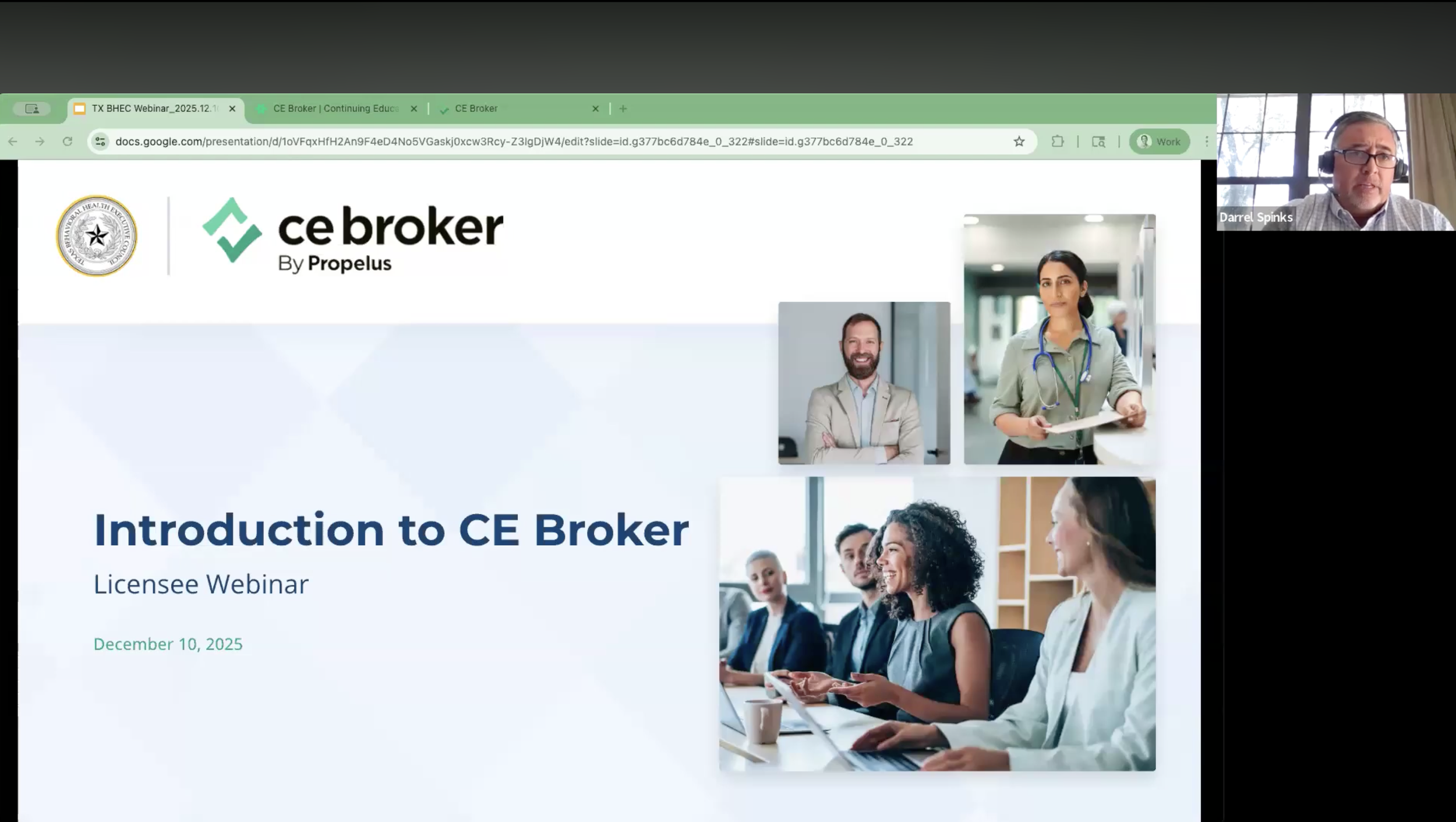
CE reporting has changed for all BHEC licensees. As of January 1, 2026, all continuing education must be tracked and reported through CE Broker. Learn more in our previous blog for a deeper dive into navigating the platform.
BHEC provided an update on the online CE management system, CE Broker, for license renewals.
Use of CE Broker is now mandatory for license renewal as of January 1, 2026. Staff reported the system is running smoothly with relatively minor issues. Approximately 28,000 licensees (about 32%) have created CE Broker accounts so far, with higher adoption rates among those approaching renewal deadlines.
BHEC staff outlined an extensive notification process for licensees approaching renewal: email notifications at 90 days before renewal, a postcard mailed to the licensee's address, monthly reminder emails from CE Broker, and additional personalized emails from BHEC staff for those who still lack accounts as their renewal date approaches.
Takeaway: CE Broker is now required for license renewal. If you have not yet created your account, do so before your next renewal period. The system accepts half-hour CE credit increments.
Have questions or need support with utilizing CE Broker? See the link to our previous blog in the sidebar for a deeper dive into navigating the platform.
School Psychology Retraining Program (ACU & Region 20 MOU)
In one of the most significant action items of the meeting, the Council unanimously approved a Memorandum of Understanding (MOU) with Abilene Christian University (ACU) and Education Service Center Region 20 to formally recognize a new school psychology retraining program.
This first-of-its-kind program creates an alternative pathway to licensure as a Licensed Specialist in School Psychology (LSSP) for working professionals already in schools. The program is designed for individuals with a master's degree and at least three years of experience in school settings—such as educational diagnosticians, school counselors, school social workers, and speech-language pathologists—who want to become school psychologists.
Key details about the program:
Two-year program: intensive coursework and practicum in the first year, followed by a 1,200-hour internship in the second year.
Distance education format with synchronous and asynchronous instruction, plus two in-person residency visits to Abilene.
Cohorts of 10–15 students, with starts in January, May, and August.
The first cohort started in January 2026, with students from across the state, many from small and rural districts.
The program received over 115 applications for its next cohort starting in May, with only 15 spots available.
First graduates are expected in December 2027.
The MOU guarantees that graduates will meet licensure requirements, eliminating the uncertainty applicants often face about whether their education will qualify.
Why this matters: 42% of Texas counties have zero licensed school psychologists. This program was born out of post-Uvalde discussions about expanding the behavioral health workforce in underserved areas. BHEC staff noted that other programs are already expressing interest in replicating this model, and that the counseling profession may be the most likely next candidate for a similar alternative pathway due to its relatively flexible statutory framework.
Takeaway: If you are a working school professional with a master's degree interested in becoming a school psychologist, visit the ACU website for application information. This is currently a Texas-only pathway to licensure.
Texas Psychology Licensing Exam Initiative
In a February 26, 2026 email to licensees, BHEC announced that the Association of State and Provincial Psychology Boards (ASPPB) is seeking volunteers for examination and item development committees:
———
ASPPB Calls for Volunteers for Examination and Item Development Committees
The Association of State and Provincial Psychology Boards (ASPPB)® is seeking licensed/registered psychologists from all career stages and who represent work, demographic, and professional diversity to serve on the Item Development Committee (IDC) and the Examination Committee (ExC) for the integrated Examination for Professional Practice in Psychology (EPPP).
Psychologists who apply may be practitioners, academics, researchers, and/or consultants who are well-versed in the practice of the profession. ASPPB is particularly seeking individuals with knowledge and experience in one or more of the domains to be assessed by the new integrated EPPP. These domains are: (1) Scientific Orientation to Practice, (2) Assessment, (3) Intervention, (4) Consultation and Supervision, (5) Interpersonal Relationships, and (6) Ethical and Professional Practice.
Item Development Committee (IDC) members are charged with training, collaborating with, and helping recruit item writers in the creation of items for the EPPP. The committee will comprise approximately 11 members who have demonstrated subject-matter expertise in one or more of the content areas measured by the Exam. Competitive candidates appointed to the IDC will be members of the field who have demonstrated a commitment to excellence through their professional accomplishments.
The IDC holds one meeting each year and at least one Item Writer Workshop. Additionally, there will be one Bank Maintenance Meeting every other year in conjunction with the EPPP ExC. Each meeting typically lasts two days. To effectively carry out their responsibilities, members must attend each meeting in its entirety. Travel expenses for these meetings will be reimbursed in accordance with ASPPB’s established policies. Committee members will typically serve 4-year terms with the option to renew for a second 4-year term; however, the initial cohort of committee members will have terms lasting between 2 and 4 years to stagger term lengths.
Any questions about the IDC or the responsibilities of Committee members should be addressed to Peter Graf (pgraf@psych.ubc.ca) or Joel Kamper (jkamper.phd@gmail.com).
Exam Committee (ExC) members are charged with reviewing and finalizing the exam forms for the integrated EPPP prior to their administration. The committee will be comprised of approximately 11 members who have demonstrated subject-matter expertise in one or more of the content areas measured by the Exam. Competitive candidates appointed to the ExC will be members of the field who have demonstrated a commitment to excellence through their professional accomplishments.
The ExC holds two meetings each year. Each meeting typically lasts 2.5 days. Additionally, there will be one Bank Maintenance Meeting every other year in conjunction with the EPPP IDC. During the member’s term, they may be invited to attend and observe one Item Writer Workshop to assist in developing items in their area of expertise. To effectively carry out their responsibilities, members must attend each ExC meeting in its entirety. Travel expenses for these meetings will be reimbursed in accordance with ASPPB’s established policies. Committee members will typically serve 4-year terms with the option to renew for a second 4-year term; however, the initial cohort of committee members will have terms lasting between 2 and 4 years to stagger term lengths.
Any questions about the ExC or the responsibilities of Committee members should be addressed to Ian Nicholson (inichols@uwo.ca) or Daniel Tranel (Daniel-tranel@uiowa.edu).
Applications for the IDC and ExC will be reviewed by the ASPPB Committee on Exam Coordination (CEC) and approved by the ASPPB Board of Directors (BOD). In making recommendations to the ASPPB BOD, the CEC will consider a variety of factors, including subject-matter needs, diversity considerations, geographic representation, and other relevant factors.
Interested candidates should complete the online survey, as well as submit a statement of interest and an up-to-date CV to Emelyn East (eeast@asppb.org) no later than March 23, 2026. Existing or past members of the EPPP (Part 1-Knowledge) and the EPPP (Part 2-Skills) Examination or Item Development Committees, item writers, and other new ASPPB volunteers are welcome to apply.
———
BHEC continues exploring development of a Texas-owned psychology licensing exam. Staff reported ongoing progress including a national survey, stakeholder working groups focused on the academic community, and engagement with a technical advisory committee of psychometrics experts.
The timeline discussed includes a decision document for the psychology board at its May meeting, a draft Request for Proposal (RFP) for the Council at the June meeting, vendor bids to inform cost and timeline estimates, and those estimates taken to the legislature in the next session.
Meanwhile, the Association of State and Provincial Psychology Boards (ASPPB) recently abandoned its mandate for the EPPP-2 and is now pursuing a complete reimagining of the national exam. BHEC staff attributed this reversal directly to Texas's firm opposition. ASPPB has committed to releasing pricing information soon, with beta testing expected this fall and potential adoption in spring 2027.
Key concerns driving Texas's continued exploration include cost and pricing transparency (ASPPB has not yet released pricing for the new integrated exam), lack of access to supporting efficacy data (the proprietary nature of the exam has prevented independent review), and the monopoly dynamic of a single exam provider backed by state regulatory force.
Staff emphasized that Texas has never said it is abandoning the national exam or reciprocity, and that multiple other states have expressed interest in what Texas is developing.
Takeaway: The national EPPP exam is undergoing a significant redesign. Texas is simultaneously evaluating whether developing its own exam could provide greater flexibility and cost control. The earliest potential implementation for a Texas exam would be around 2029. Both pathways are being explored in parallel.
Note: ASPPB is seeking licensed/registered psychologists from all career stages and who represent work, demographic, and professional diversity to serve on the Item Development Committee (IDC) and the Examination Committee (ExC) for the integrated Examination for Professional Practice in Psychology (EPPP). See more information in the sidebar.
Spanish-Language Social Work Exam
The agency provided an update on efforts to implement a legislative budget rider requiring development of a Spanish-language social work licensing exam. Staff reported meeting with both ASWB and NASW-TX to explore options.
However, the agency faces significant structural and financial barriers. The allocated funding is not sufficient to develop a Spanish-language exam independently. ASWB is exploring whether instant translation might serve as an ESL-type accommodation, but has not yet responded with cost estimates or feasibility details.
Staff indicated that a decision point is approaching—likely by May or June—at which time the agency will either have an actionable plan in place or will need to report back to the legislature that the mission could not be accomplished and lapse the funds.
Takeaway: Development of a Spanish-language social work licensing exam remains a priority, but significant barriers exist. The agency is continuing to work with ASWB to explore options, including potential translation accommodations. Licensees should not expect immediate changes but may see developments later this year.
Complainant Identity in Enforcement
At the request of the Council Chair, the agenda included a discussion about whether BHEC should stop sharing a complainant's identity with the person a complaint is filed against.
The concern originated from a public comment at a prior meeting about the chilling effect on reporting when supervisees or colleagues fear retaliation for filing complaints.
After discussion, staff and the Council determined that changes are not warranted at this time for several reasons: BHEC lacks the specific statutory authority that other agencies (like the medical board) have to withhold complainant identity; most cases involving clinical issues would require the complainant to testify, making anonymity impractical; knowing the complainant's identity can help identify when complaints are filed for anti-competitive or improper motives; and this type of change may be more appropriate for the legislature to address across all agencies rather than on a piecemeal basis.
Executive Director Daryl Spinks noted that BHEC staff is willing to work with individuals who are struggling with whether to file a complaint. In certain circumstances, staff has signed complaints themselves to protect the identity of the person who brought the concern forward. Licensees in this situation are encouraged to call the agency to discuss their options.
Takeaway: The complaint process will continue to include complainant identification. However, if you are concerned about filing a complaint due to potential retaliation, BHEC staff is available to discuss your situation and may be able to help navigate the process. Retaliation against someone for filing a complaint would likely constitute a rule violation in itself.
Connecting the Public With Licensees
The Council had planned to discuss strategies to help the public find licensed mental health providers. The item was tabled for a future meeting at the request of Councilman Taylor.
Annual Rulemaking Window (Proposed Approach)
Staff recommended creating a structured annual rulemaking schedule. Under this approach, one Council meeting (tentatively June) would be designated for proposing rules for public comment, and a later meeting (tentatively October) would be designated for adopting final rules.
The proposal is driven by feedback from licensees that rule changes happen too frequently to track, the significant staff workload involved in managing staggered rulemaking cycles, and the challenge of conducting rulemaking during legislative sessions.
This is not a formal rule or policy change—it is a self-imposed operational framework that the Council can deviate from at any time if urgent rulemaking is needed. Member boards can continue their internal rulemaking processes on any timeline; the window applies only to when proposals reach the Council level.
Takeaway: Future rule changes may follow a more predictable annual schedule, making it easier for licensees to track what is changing and when.
Rulemaking
Petition for Rulemaking (Rule 884.11)
The Council considered a formal petition for rulemaking submitted by representatives of NASW-TX and the Texas Counseling Association requesting changes to Rule 884.11 governing Informal Settlement Conferences (ISCs).
The petition would have required licensed professional board members to participate in ISC disciplinary review panels when complaints involve clinical issues.
After extensive discussion, the Council voted to deny the petition. Staff and Council members clarified several points: the current rule does not exclude board members from ISCs—it simply does not require their presence; staff will generally still invite board members when available; the Executive Director (not line staff) makes the determination about whether a board member is needed; if a case involves professional standards that require expert judgment, a board member or expert reviewer would be consulted before the case could proceed to SOAH; individual member boards retain oversight authority and can review closed cases; and any Council or board member can request to review any file at any time as part of their oversight role.
Outcome: The Council voted to deny the petition.
Takeaway: The current ISC structure remains in place. Board member participation in ISCs is expected to continue in practice for cases involving clinical judgment, but is not formally required.
BHEC Rules Adopted
The Council adopted updates to several BHEC rules, including:
881.2 – Definitions
882.42 – Criminal history ineligibility
882.60–882.61 – Military service member licensing provisions
884.11 – Informal conferences
885.1 – Executive Council fees (with a minor typographical correction to remove an outdated effective date reference from the fee chart graphic)
Takeaway: These updates primarily address administrative definitions, licensing provisions, and disciplinary procedures.
LMFT Board
Adopted rule updates included:
801.2 – Definitions
801.57 – Child custody evaluations
801.112–801.113 – Academic requirements
801.204 – Military licensing provisions
Takeaway: LMFT rules were updated to align academic requirements and military licensing provisions.
Psychology Board (TSBEP)
Several psychology rules were adopted or updated, including rules addressing Licensed Psychological Associate, Licensed Specialist in School Psychology, supervised experience requirements, examination requirements, supervision standards, forensic services, termination of services, and school-based psychological services.
Takeaway: Psychology rule updates addressed licensing pathways, supervision, and forensic practice standards.
LPC Board
Adopted rule updates included:
681.53 – Child custody and adoption evaluations
681.114 – Military service member licensing provisions
Takeaway: Changes largely clarified evaluation standards and military licensing processes.
Social Work Board
The Social Work Board adopted a large set of updates, including rules addressing definitions and scope of practice, supervision and independent practice rules, licensure requirements, documentation standards, recognition as a supervisor, types of supervision, clinical supervision for LCSW, independent practice recognition, and the sanctions schedule.
During discussion, staff clarified that the accreditation provisions align exactly with statute (which treats LBSW/LMSW applicants from programs seeking accreditation differently from LCSW applicants) and that while non-social-work supervisors supervising social work practice would technically be subject to the social work supervision rules, they would not face sanctions from the social work board since they don't hold a social work license.
Takeaway: These changes primarily modernize supervision structures, licensing processes, and enforcement provisions. Non-social-work supervisors who supervise social work practice should be aware of the applicable supervision standards.
Member Board Updates
LMFT Board
The LMFT board is developing proposed changes to CE rules aimed at creating more flexibility and reducing the number of required category "buckets." A survey of supervisees has been completed, with preliminary results indicating that graduate education alone does not fully prepare students for independent practice (confirming the essential role of supervision), and that widespread exploitation or harmful supervision does not appear to be a systemic issue. A supervisor survey is planned for this summer, with potential rule changes or guidance documents to follow.
The LMFT board is also working to broaden its definition of "technology-assisted services" beyond just telehealth to include AI, electronic health records, and other technology used in practice.
LPC Board
The LPC board expanded ISC eligibility to all nine board members (previously handled by rotation) in response to increasing complaint volumes. The board also restructured its complaints committee to focus on identifying trends driving complaint increases and proposing proactive solutions rather than only conducting ISCs.
Psychology Board
The psychology board's primary updates—the exam development initiative and the ACU retraining program—were covered earlier in the meeting. A ketamine-assisted therapy town hall held in December was also discussed, with the Council noting that psychedelic-assisted therapy, AI in clinical practice, and other emerging modalities will continue to be areas of focus.
Social Work Board
The social work board noted national efforts through ASWB to align supervision practices across states, as well as continued monitoring of the social work interstate compact.
Whew, that was a productive meeting (just shy of 3.5 hours)! Regulatory meetings like this one may be long, but they provide important insight into the policies, priorities, and challenges shaping mental health practice in Texas. We hope this recap helps you stay informed about the conversations happening at BHEC and what they may mean for clinicians across the state.

References
Texas Behavioral Health Executive Council. (2026, February 17). Texas Behavioral Health Executive Council meeting (Meeting agenda, materials, and recording). https://bhec.texas.gov/sample-page/important-dates/past-council-meeting-dates/
Texas Behavioral Health Executive Council. (2026, February 26). ASPPB calls for volunteers for examination and item development committees [Email announcement].
Questions? Suggestions or topics you'd like us to cover? Let us know in the comments.
Guided by Wisdom. Rooted in Practice. Grown with Passion.
A Quick Disclaimer (Because It Matters)
This recap is intended for informational and educational purposes only and reflects a summary interpretation of the relative BHEC meeting. It is not an official transcript, legal opinion, or regulatory directive. Licensees are responsible for reviewing board rules, statutes, and formal guidance directly through the Texas Behavioral Health Executive Council (BHEC) and their licensing board/s. For specific legal, ethical, or licensure questions, consult the relevant statutes, administrative code, or qualified legal counsel.